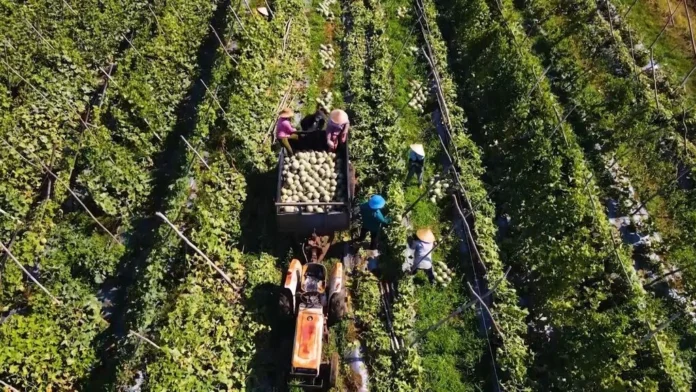
Arabfields, Farah Benali, Economic Correspondent in China — As Vietnam’s agricultural sector stands on the cusp of a transformative era, the year 2026 promises to mark a pivotal shift toward emphasizing quality and sustainability in its products, a move driven by global market demands and internal strategic planning. Drawing from the robust performance recorded throughout 2025, the nation is poised to not only maintain but significantly elevate its position in the international arena.
In the first eleven months of 2025 alone, exports of agricultural, forestry, and fishery products reached approximately $64 billion, reflecting a substantial increase compared to the previous year and already surpassing the full-year total achieved in 2024. This strong growth, combined with an estimated trade surplus of around $21 billion, demonstrates the sector’s remarkable resilience in the face of natural disasters, climate variability, and disease outbreaks. Looking forward, many analysts expect that by integrating sustainable practices more deeply and consistently across the value chain, Vietnam could see its export figures climb even higher, potentially reaching $70 billion or more by the end of 2026, as international buyers increasingly reward eco-friendly, traceable, and high-quality goods with premium prices.
The agricultural contribution to GDP in 2025 grew by roughly 3.9 percent, exceeding official targets and once again highlighting the sector’s vital role in the national economy. This positive momentum is widely expected to continue into 2026, with projections suggesting an average growth rate of around 4.2 percent, supported by accelerated investments in modern technology, digital traceability systems, and genuinely sustainable farming methods.
Fishery products are on track to achieve record export revenues between $11.2 and $11.3 billion in 2025, with particularly strong performances in processed seafood, squid, octopus, and various marine fish species. In the coming year, as sustainability certifications become more widespread and rigorous, these exports could expand by an additional 15 percent, allowing Vietnamese producers to capture a larger share of environmentally conscious consumers in Europe, North America, and other high-value markets.
Coffee has already become a standout success story, with export revenues surpassing $8 billion in 2025. This achievement stems from deliberate efforts in deep processing, technological modernization, and a clear focus on specialty, instant, organic, roasted, and ground varieties that align well with global value chains. This strategic orientation toward high-value, environmentally responsible products is forecasted to push coffee revenues beyond $9 billion in 2026, as Vietnamese producers strengthen their presence in premium segments through widely recognized certifications such as fair trade, Rainforest Alliance, and organic labels.
Cashew nuts have maintained Vietnam’s position as a global leader despite intensifying competition from African suppliers. This resilience has been achieved through diversified distribution channels, sophisticated risk management, and continuous improvement in processing techniques. Predictions indicate that by placing even greater emphasis on sustainable sourcing, quality assurance, and responsible labor practices, cashew exports could experience a solid increase of 10 to 12 percent in 2026, further consolidating Vietnam’s dominant market position.
Across virtually all product categories, quality improvements have yielded impressive results: the number of warnings issued by the European Union concerning Vietnamese agricultural products dropped by approximately 50 percent in 2025. This positive trend is expected to accelerate dramatically in 2026. Full compliance with major regulations such as the EU Deforestation Regulation should reduce such warnings to nearly zero, thereby facilitating significantly higher trade volumes with one of the world’s most demanding and lucrative markets.
Rice exports, while still very significant, encountered some headwinds in 2025 due to policy changes in traditional large buyers such as the Philippines and Indonesia. However, strong gains in African markets and a notable recovery in shipments to China largely offset these losses. Forecasts suggest that continued diversification, combined with a stronger focus on premium white and scented varieties as well as sustainable production methods, could enable rice exports to rebound and exceed 2025 levels by around 8 percent in 2026.
Vietnamese agricultural products now reach nearly 200 countries and territories worldwide. Successful expansion beyond traditional partners — including deeper penetration into Japan, South Korea, Australia, New Zealand, the Middle East, and Singapore — has proven highly effective. Even in the challenging U.S. market, where tariffs have been applied, exports have continued to grow thanks to product restructuring and smart utilization of existing trade preferences. In 2026, this diversification strategy is widely expected to further reduce exposure to geopolitical and commercial risks, potentially delivering a 10 percent increase in shipments to fast-growing emerging markets across Africa, South Asia, and parts of Latin America.
Nevertheless, important vulnerabilities remain. Over-reliance on the Chinese market for fresh fruits (especially dragon fruit and bananas), as well as for rubber and cassava, and on the United States for wood derivatives and certain legumes, continues to represent a structural weakness. Proactive policy measures in 2026, including the negotiation of new trade agreements and the development of alternative markets, are anticipated to gradually reduce this dependency by approximately 20 percent, creating a more balanced and resilient export structure.
Global economic and trade conditions are likely to remain volatile in 2026, with continued logistical challenges, rising protectionism, tariff barriers, and quota restrictions affecting many supply chains. In this uncertain environment, Vietnam’s ability to adapt quickly, invest in resilient logistics, and strengthen regional partnerships through free trade agreements and improved trade facilitation is expected to transform potential threats into competitive advantages.
Sustainability has become an absolute requirement rather than an option. Importers, particularly in Europe, now demand fundamental changes in production methods, supply-chain organization, and full traceability. Vietnam is actively implementing a detailed compliance roadmap for the EU Deforestation Regulation, which is not only essential for preserving access to the European market but also serves as a powerful catalyst for a broader ecological transition across the entire agricultural sector. By the end of 2026, the large majority of exported products are expected to fully meet deforestation-free criteria, significantly boosting buyer confidence and potentially increasing EU-bound shipments by 15 percent or more.
The combination of public-private partnerships, pilot programs in key provinces, development of national forest and plantation databases, technical guidelines for geolocation and traceability, and continuous dialogue with international partners is laying the groundwork for a modern, transparent, and low-carbon agricultural system. These efforts, if sustained with determination, should position Vietnam as one of the most credible and forward-looking suppliers of sustainable tropical agricultural products on the global stage by the close of 2026.
In summary, while the precise export targets for 2026 have not yet been officially quantified, the clear strategic focus on quality enhancement, sustainability, traceability, carbon footprint reduction, and market diversification strongly suggests continued robust growth. By successfully executing this transformation, Vietnam is expected not only to protect its existing revenues but also to unlock significant new opportunities in premium segments, establishing itself as a global reference in responsible and high-value agriculture.