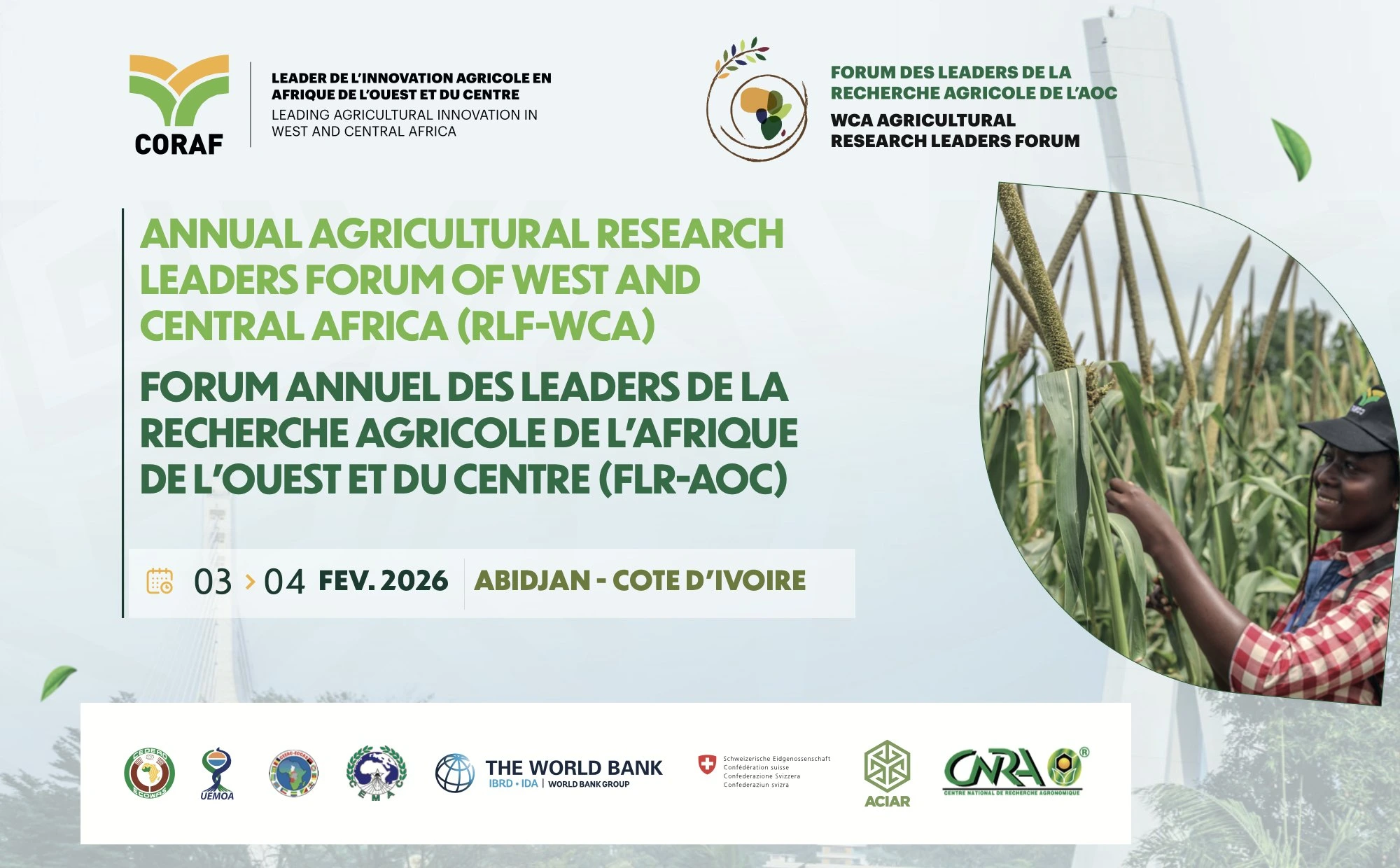
Arabfields, Nadia Fatima Zahra, Arabfields, Yamoussoukro, Ivory Coast — The 4th Forum of Leaders in Agricultural Research for West Africa (FLR-AOC), held in Abidjan on February 3 and 4, 2026, has concluded with a clear consensus: innovative financing mechanisms are now the cornerstone of efforts to strengthen agricultural research and ensure long-term food security across the region. Gathering researchers, policymakers, funding agencies, private-sector representatives, and international partners, the two-day event positioned Abidjan as a living laboratory for testing and scaling new funding models that move beyond traditional donor dependency toward sustainable, regionally driven investment in agricultural innovation.
Over the course of intensive sessions, participants examined the persistent underfunding that has long constrained agricultural research in West Africa. Despite the region’s heavy reliance on agriculture for both employment and food production, public research budgets remain chronically low, leaving scientists struggling to address pressing challenges such as climate variability, soil degradation, pest pressures, and post-harvest losses. Speakers repeatedly highlighted that incremental increases in government allocations will not suffice; instead, the future lies in blended finance approaches that combine public funds, private investment, impact-driven instruments, and revenue-generating research products.
A central theme that emerged was the urgent need to create dedicated regional funding instruments tailored specifically to agricultural research. Several proposals focused on establishing an autonomous West African Agricultural Research Innovation Fund, capitalized through contributions from member states, regional development banks, and earnings from commercialized research outputs. Such a fund would operate with clear governance rules, prioritizing projects that deliver measurable impacts on smallholder productivity and resilience. Participants pointed to early pilot initiatives in Côte d’Ivoire and neighboring countries as proof that locally managed funds can attract additional international resources while retaining decision-making authority within the region.
Discussions also explored the growing role of private-sector partnerships. Agribusiness companies expressed willingness to co-finance research that aligns with their supply-chain needs, particularly in high-value crops and climate-smart technologies. Impact investing and green bonds were presented as promising tools to channel capital toward research outcomes that simultaneously generate financial returns and social benefits. By structuring investments around verifiable indicators, such as increased yields or reduced pesticide use, these instruments could unlock substantial new resources that traditional grants cannot provide.
The forum devoted considerable attention to building national and regional capacity to design, manage, and monitor innovative financing arrangements. Many countries still lack the institutional frameworks needed to absorb and effectively deploy blended finance. Participants therefore called for targeted training programs and technical assistance to strengthen ministries of agriculture, research institutes, and financial regulatory bodies. The goal is to create an ecosystem in which public research organizations can confidently negotiate partnerships, protect intellectual property, and retain a fair share of benefits from commercialized innovations.
Looking ahead, the momentum generated in Abidjan is expected to translate into concrete advances within the next five to ten years. If the proposed regional innovation fund materializes and attracts even modest initial capitalization, annual research investment in West Africa could double by 2030, enabling a new generation of climate-resilient crop varieties, improved soil management practices, and digital tools tailored to smallholder realities. Higher and more predictable funding will accelerate the development of drought-tolerant maize and rice varieties, shorten breeding cycles through advanced genomic techniques, and expand precision agriculture applications that reduce input costs for farmers.
These research gains will feed directly into broader food security objectives. By 2035, widespread adoption of improved technologies emerging from better-funded research programs could lift crop yields by 20 to 30 percent across major staples, narrowing the gap between current production and regional demand. Post-harvest loss reduction technologies, long neglected due to funding constraints, would receive renewed attention, potentially saving hundreds of thousands of tons of grain and tubers each year. Integrated pest management systems grounded in local research would decrease reliance on imported chemicals, lowering costs for farmers and reducing environmental damage.
The economic ripple effects promise to be substantial. A more innovative and productive agricultural sector will create jobs along expanded value chains, from seed production to processing and marketing. Rural households will see higher and more stable incomes, slowing urban migration pressures and strengthening community resilience. As West African research institutions gain financial autonomy and international recognition, they will attract top talent and foster south-south collaboration, positioning the region as a global leader in tropical agricultural science.
Perhaps most critically, sustained investment in research will equip West Africa to confront the escalating challenges posed by climate change. Rising temperatures, shifting rainfall patterns, and increased frequency of extreme weather events threaten to reverse hard-won development gains. Yet with adequate funding, researchers can develop and disseminate adaptive practices that maintain productivity under stress conditions. Early warning systems, conservation agriculture techniques, and diversified cropping strategies will become standard rather than experimental, helping millions of farming families withstand shocks that would otherwise plunge them into poverty.
The Abidjan forum has thus marked a turning point. By framing innovative financing not as an optional supplement but as an essential driver of agricultural transformation, participants have laid the intellectual and political groundwork for systemic change. The coming years will reveal whether governments, regional organizations, and private partners can translate this shared vision into action. Success will depend on political will, transparent governance, and continued dialogue among all stakeholders. If these conditions are met, the decisions taken in Abidjan in early 2026 will be remembered as the moment West Africa secured the financial foundation needed to feed its growing population and build a resilient agricultural future for generations to come.