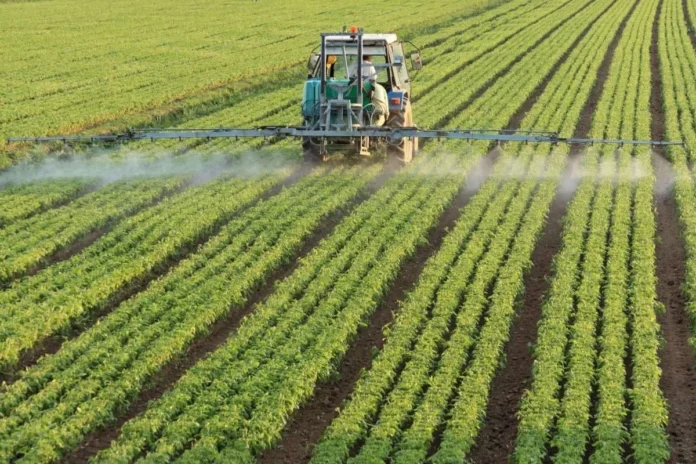
Arabfields, Lamia Cherifa, Special Economic Correspondent, Moscow, Russia — In early 2026 the global fertilizer industry encountered fresh turbulence when Russian authorities announced a temporary suspension of ammonium nitrate export licenses extending through mid-April. This measure halted the validity of all previously issued permits and prevented the approval of new ones outside of select intergovernmental contracts. The decision stemmed from a strategic effort to prioritize the domestic agricultural sector during the critical spring planting season when demand for nitrogen-based fertilizers surges to support uninterrupted fieldwork across vast farmlands. Officials emphasized that rising international orders for nitrogen fertilizers had created pressure on local supplies prompting the one-month restriction to safeguard national food production priorities.
The move arrives at a delicate juncture for the worldwide fertilizer trade which remains dominated by a limited group of major producing and exporting nations. Russia has long held a commanding position in this arena bolstered by its abundant natural gas resources essential for manufacturing ammonia and its derivatives including ammonium nitrate a white granular compound with the chemical formula NH4NO3 widely applied to enhance crop yields. By channeling available stocks toward internal needs the policy aims to mitigate any shortfall that could disrupt the timely application of fertilizers and thereby threaten harvest outcomes in the coming months. Yet this internal focus introduces immediate uncertainties for importing countries that have relied on consistent Russian deliveries to meet their own agricultural timelines.
Compounding the situation are parallel developments elsewhere in the market. China the foremost global producer and consumer of fertilizers instituted export curbs on urea in late 2025 with those limitations extended into August 2026 to preserve adequate domestic availability amid its own intensive farming cycles. Such coordinated actions from leading suppliers underscore a broader pattern of nations turning inward to secure their agricultural foundations especially as external demand intensifies. The interplay between these policies heightens the risk of supply bottlenecks for nitrogen fertilizers a category that includes both ammonium nitrate and urea critical for stimulating plant growth and ensuring robust yields of staple crops such as wheat corn and rice.
Geopolitical factors further amplify the strain on international fertilizer flows. Escalating tensions involving Iran Israel and the United States have disrupted maritime routes through the Strait of Hormuz a vital chokepoint that handles approximately one-third of global seaborne fertilizer transport equivalent to nearly 16 million tons annually with urea comprising 67 percent of that volume. These interruptions have already driven notable price escalations according to recent market assessments with average fertilizer costs rising by 27 percent overall and nitrogen fertilizers experiencing increases between 30 and 40 percent. The resulting volatility reverberates through supply chains affecting not only immediate procurement but also longer-term planning for farmers and agribusinesses worldwide.
Reflecting on recent history reveals how Russia previously capitalized on similar global shifts. Following the gas supply adjustments of 2022 European reductions in Russian energy imports generated a surplus within the domestic market enabling expanded production of ammonia and urea. This dynamic solidified Russia’s standing as the preeminent fertilizer exporter achieving an 18.7 percent share of the global market by 2023 and maintaining that influence into 2025 through sustained output advantages. The current export limitation therefore marks a departure from that expansionary approach signaling a tactical recalibration rather than a permanent withdrawal. Market observers anticipate that once the spring planting concludes and domestic requirements stabilize shipments may resume albeit potentially at moderated volumes to accommodate any lingering internal priorities.
Looking ahead projections grounded in prevailing data suggest several plausible trajectories for the fertilizer sector through the remainder of 2026 and into 2027. Should the temporary restriction evolve into a recurring pattern or should comparable measures spread among other key players nitrogen fertilizer prices could climb an additional 15 to 25 percent by the third quarter of 2026. Such an uptick would stem from accumulated deferred demand and persistent logistical challenges in alternative shipping corridors. Importing regions particularly in sub-Saharan Africa Southeast Asia and parts of Latin America where fertilizer dependency underpins food security for nearly half the world’s population may face elevated input costs. Farmers in these areas could respond by scaling back application rates which in turn risks diminishing crop productivity by 10 to 20 percent per hectare for major cereals based on established agronomic models linking nutrient availability to yield outcomes.
On a macroeconomic scale these developments carry implications for global inflation and trade balances. Higher fertilizer expenses translate into increased food production costs that eventually filter through to consumer prices potentially adding upward pressure on staple commodity indices. In 2026 projections indicate that a sustained 30 percent premium on nitrogen fertilizers might elevate overall agricultural production expenses by 5 to 8 percent in net-importing economies thereby influencing national budgets and prompting calls for subsidy programs or alternative sourcing strategies. Meanwhile exporting nations outside the primary group may seek to accelerate their own output expansions to capture market share vacated during the Russian pause. Countries with established phosphate and potash capacities could integrate more nitrogen production lines though such adaptations require substantial capital investment and time frames extending beyond 12 months.
Environmental considerations also warrant attention in this evolving landscape. Ammonium nitrate’s role in intensive agriculture contributes to both productivity gains and potential nitrate runoff concerns yet its efficient deployment remains central to sustainable yield improvements. Future forecasts envision a gradual shift toward precision application technologies that optimize fertilizer use and reduce waste thereby mitigating some of the economic burdens arising from supply constraints. By late 2026 analysts foresee that technological adoption combined with diversified supplier networks could temper price volatility reducing the projected annual fluctuation range from 25 percent to approximately 12 percent assuming no further geopolitical escalations.
The concentrated nature of the fertilizer market with its reliance on a handful of influential actors underscores the vulnerability of global food systems to policy adjustments in any single jurisdiction. Russia’s decision while framed as a short-term domestic safeguard illustrates the delicate equilibrium between national interests and international obligations. As the April 21 deadline approaches industry participants will monitor resumption signals closely evaluating whether the measure serves merely as a seasonal adjustment or foreshadows a more structural reorientation. In the interim stakeholders across the agricultural value chain from producers to policymakers are advised to explore hedging mechanisms diversified procurement agreements and enhanced storage capacities to buffer against anticipated disruptions.
Broader forecasts for 2027 and beyond anticipate a stabilization phase if current restrictions prove transitory. Under baseline scenarios derived from observed 2026 trends global nitrogen fertilizer availability could rebound by 8 to 12 percent once major exporters realign their strategies fostering a return to pre-crisis price levels adjusted for inflation. However persistent maritime risks or additional export controls might prolong elevated costs extending the period of market tightness into the first half of 2027. In response collaborative initiatives among importing nations could emerge focusing on joint purchasing frameworks or investment in domestic fertilizer manufacturing to lessen external dependencies over the medium term.
Ultimately the Russian export limitation serves as a reminder of the intricate linkages binding energy resources agricultural inputs and global food security. With nearly half the global population depending on crops sustained by nitrogen phosphate and potash fertilizers any disruption in supply chains carries profound ramifications for economic stability and human well-being. As 2026 unfolds the fertilizer industry stands at a crossroads where short-term policy choices will shape long-term market dynamics influencing everything from farm gate profitability to international commodity flows. Prudent planning and adaptive measures will be essential to navigate the uncertainties ahead ensuring that agricultural productivity keeps pace with rising global demand.