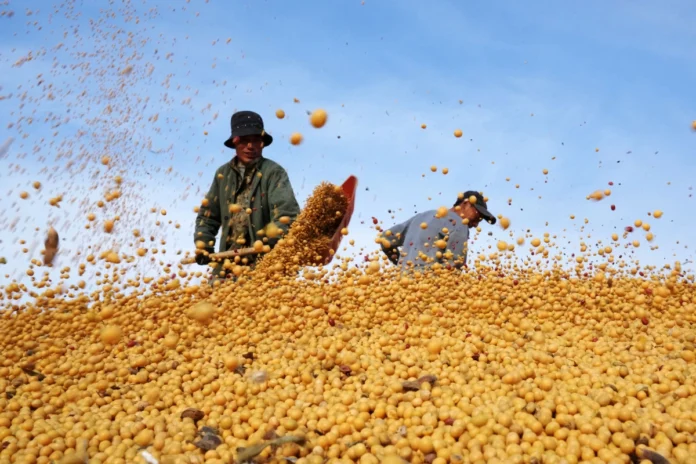
Arabfields, Naïla Mokhtari, Correspondent, São Paulo, Brasil — Soybean prices at Brazil’s Paranagua port recovered on Tuesday after two consecutive daily declines, highlighting the strength of demand for Brazilian supplies as farmers move into the new planting season.
The Cepea/Esalq soybean indicator rose 0.52% on Sept. 29 to 161.27 reais ($30.92) per 60-kilogram bag. The increase came despite recent pressure on prices and an increasingly active planting campaign across Brazil.
For farmers and traders, the move offers some relief after a period of softer prices. Soybean markets remain closely watched at this time of year because decisions made now on sales, storage and planting can have a direct impact on farm revenues in the months ahead.
Prices in Paranagua had fallen 0.35% on Sept. 28 and 0.52% on Sept. 25. Even so, the market remained 1.15% higher for the month through Tuesday, showing that the recent declines had not erased September’s gains.
Demand remains an important source of support. Brazil is entering the 2026/27 crop with significant commercial interest in its soybeans, while the pace of planting is beginning to increase. National planting had reached 3.9% of the expected area, ahead of the 3.5% recorded at the same point last year and above the five-year average of 3.6%.
In Parana, one of Brazil’s leading soybean-producing states, planting has moved even faster. The state had completed 28% of its projected soybean area, the fastest pace for the period since the 2018/19 season. Favorable soil moisture and efforts by farmers to advance planting have contributed to the acceleration.
The faster start could gradually change the balance of the market. As the new crop develops, expectations of larger supplies may limit the scope for sustained price increases. At the same time, strong export demand and tighter availability of old-crop soybeans could continue to provide support in the short term.
The latest figures from Parana point to a potentially large harvest. The state’s preliminary estimate puts 2026/27 soybean production at 22.6 million tonnes, which would represent a record if achieved.
That outlook creates a delicate situation for producers. Higher prices improve returns on soybeans still available for sale, but expectations of a larger crop could encourage buyers to become more cautious as the harvest approaches.
The next few weeks are therefore likely to be shaped by two competing forces, firm demand for Brazilian soybeans and expectations of increasing supply from the new crop. Weather will also remain a critical variable, particularly as planting accelerates across Brazil.
If export demand remains strong while the new crop progresses without major weather disruptions, prices in Paranagua could remain relatively firm in the near term, although gains may become more difficult to sustain as additional 2026/27 supply enters the market.
For farmers, the immediate focus is increasingly shifting from the price of the crop already available to the conditions of the crop now going into the ground. The performance of the new planting, combined with export demand, will help determine whether the current firmness in soybean prices extends into the next stage of the Brazilian marketing cycle.