Algeria’s Sugar Revolution: From Import Dependency to Homegrown Sovereignty
Algeria has chosen an unlikely battleground to test the limits of its food sovereignty: sugar.
Long dependent on imported raw sugar for refining, the country has embarked on an ambitious plan to build a fully integrated sugar industry, from seed to refinery, anchored in its southern regions and designed to reduce import dependence while boosting export capacity.
This new national strategy combines industrial investment, agricultural innovation, and institutional reform. Its results are already visible: while Algeria strengthens its domestic sugar beet production, it has simultaneously secured lucrative export contracts, including a landmark deal with neighboring Libya.
From Historical Dependence to a Sugar Beet Bet
For decades, Algeria’s sugar sector revolved around the refining of imported raw cane sugar. The country’s refining capacity exceeds three million tonnes per year, far above its internal demand of roughly 1.3 million tonnes annually. This industrial overcapacity, largely fueled by imports, reflected the paradox of a nation capable of refining vast quantities but producing little of its own raw material.
The private conglomerate Cevital, long the dominant player, boasts a refining capacity of over two million tonnes per year. Meanwhile, the public sector, through Madar Holding, has reasserted its role in the market, particularly via Tafadis, a versatile unit producing white, brown, and liquid sugar at a rate of around 2,000 tonnes per day.
In 2025, the government established a new regulatory framework to oversee the entire value chain. The National Sugar Office (Office National du Sucre) was created to monitor supplies, prices, and strategic reserves, marking a new era of governance for the sector.
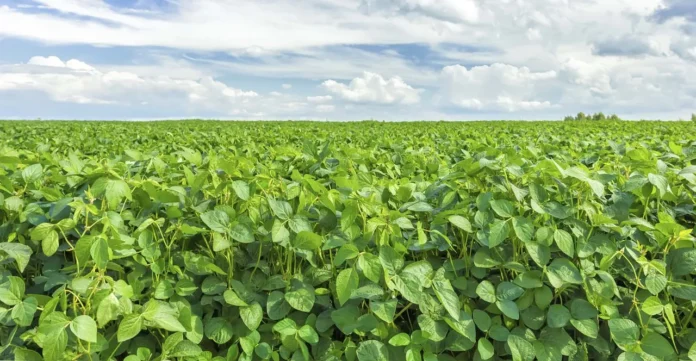
But the real turning point lies upstream. Algeria has decided to “grow” its sovereignty, literally, by cultivating sugar beet domestically. The goal: to replace part of its imported raw material with locally produced roots.
This shift requires coordinated efforts across agronomy, irrigation, and logistics, especially in the country’s southern regions, where vast tracts of land and abundant solar energy create conditions for large-scale agricultural development.
Land, Water, and Capital: The Mechanics of a Production Take-Off
The flagship of this strategy is located deep in the Sahara, at Gassi Touil near Hassi Messaoud (Ouargla). There, a concession of approximately 11,000 hectares has been granted for a period of 40 years. Around 1,000 hectares have already been planted in the pilot phase, using pivot irrigation systems adapted to arid conditions.
Initial results are promising. Field reports cite yields averaging 90 tonnes per hectare, with some plots exceeding 100 tonnes per hectare. Sucrose content—a key quality indicator—has reached up to 23% in certain areas, though industrial benchmarks generally rely on a conservative range of 16–18%, corresponding to an effective sugar extraction rate of 12–15% of the beet’s weight.
In practical terms:
- 1,000 hectares managed at 90 tonnes per hectare could yield between 11,000 and 13,500 tonnes of refined sugar per campaign.
- At full scale (11,000 hectares), output could reach 120,000 to 150,000 tonnes per year.
These figures will not replace imports overnight, but they chart a credible path toward progressive substitution, harvest after harvest.
Industrial investment follows suit. The integrated beet-to-sugar project represents an estimated 80 billion Algerian dinars (around USD 600 million), covering everything from seed selection and mechanization to processing and energy infrastructure. Partnerships with energy operators have been forged to ensure stable electricity and water supply—critical factors for irrigation and industrial continuity in the Saharan environment.
The dual objective is clear: secure raw material for domestic refineries while reducing the import bill and empowering the agricultural upstream of the sector.
Exports as Proof of Concept
Algeria’s sugar strategy would be incomplete without strong export markets. In 2025, the country signed a USD 180 million agreement with Libya for the export of 360,000 tonnes of refined sugar—equivalent to 12 shiploads of around 30,000 tonnes each. Complementary deals, combining sugar with construction materials, bring the total commercial value to roughly USD 231 million.
For now, these exports are largely derived from refined imported raw sugar. Yet they validate Algeria’s industrial and logistical competitiveness while generating valuable foreign currency. More importantly, they help amortize production assets and maintain refinery operations as domestic sugar beet output scales up.
The strategy thus unfolds in two stages: secure markets immediately, then build up domestic agriculture over several production cycles.
Five Critical Pillars for Success
As Algeria’s “sweet sovereignty” project advances, experts identify five conditions that will determine its long-term success:
- Agronomy – Selecting high-yield beet varieties, optimizing planting and harvest calendars, deploying integrated pest management, and scaling up mechanized harvesting.
- Water & Energy Management – Maximizing irrigation efficiency, ensuring reliable electricity and fuel supply, and expanding hybrid solar systems to power desert farms.
- Industrial Processing – Improving extraction rates, minimizing downtime, controlling unit costs, and valorizing by-products such as pulp and molasses.
- Logistics & Storage – Enhancing root collection, cold storage, and transportation infrastructure—particularly rail and port access—to streamline export operations.
- Pricing & Governance – Establishing multi-year contracts between farmers and processors, setting reference prices for beet, and defining the regulatory role of the National Sugar Office to cushion the sector from global price shocks.
A Long-Term Vision Rooted in Food Sovereignty
Algeria’s sugar transformation is about more than replacing imports—it’s about reclaiming control over a strategic commodity in a volatile global market. By linking agriculture, energy, and industry, the country is testing an integrated model that could later be applied to other agri-food chains, from cereals to vegetable oils.
The road ahead remains complex: developing resilient beet varieties for arid zones, maintaining water efficiency, and ensuring profitability for farmers and investors alike. Yet the direction is unmistakable.
As one industry source summarized, “Algeria is turning sugar from a dependency into a demonstration of sovereignty.”
If successful, the project could redefine the country’s agricultural map—and perhaps inspire similar initiatives across North Africa, where the quest for food independence is becoming both an economic and geopolitical imperative.