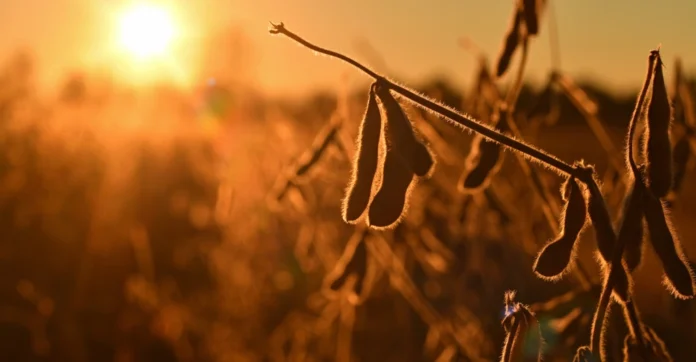
Luhansk, one of the four Ukrainian regions claimed by Russia since it launched its full-scale invasion in 2022, is expected to double its wheat harvest this year and send part of it abroad, according to local Russian-installed authorities.
Officials say the sharp rise in output underscores the growing role these territories play in Russia’s agricultural sector and reflects how the world’s largest wheat exporter is incorporating them into its strategy.
Last year, the four regions of Luhansk, Donetsk, Kherson and Zaporizhzhia — referred to by Moscow as its “new territories” but still internationally recognized as part of Ukraine — accounted for roughly 3% of Russia’s total grain harvest, according to the Agriculture Ministry. Without that contribution, a poor national crop — down 14% due to bad weather in southern Russia — would have been even smaller.
“This year we expect to gather about one million tonnes of grain, mostly wheat,” Leonid Pasechnik, the Russian-installed head of Luhansk, told reporters, including Reuters, last month. “We aimed for the same last year, but severe weather, early spring frosts and drought cut the yield to just half a million tonnes.”
At current free-on-board (FOB) market prices in Russia for August delivery, the projected 2025 harvest would be worth around $230 million. Before pro-Russian separatists took partial control of Luhansk in 2014, the region produced about 1.3 million tonnes of grain — mostly wheat — in 2013.
Kyiv regards all grain from the four regions, as well as Crimea — annexed by Russia in 2014 — as stolen. Ukrainian authorities plan to urge Western allies to sanction buyers of these crops, alleging that Russian exporters blend Ukrainian wheat with Russian supplies at Black Sea ports before shipping it abroad.
“Taking this season into account, we estimate Russia has stolen 15 million tonnes of Ukrainian grain since the start of the full-scale war,” Ukrainian Deputy Economy Minister Taras Vysotskyi told Reuters. In one case, Ukraine called on the European Union to sanction Bangladesh over wheat purchases allegedly sourced from Russian-controlled areas, but Brussels took no action. The European Commission declined to comment when approached by Reuters.
Traders told Reuters it is impossible to verify the origin of wheat once it has been mixed. Russian officials have not addressed the legal status of grain from the “new territories.” While Russia’s Agriculture Ministry includes the harvests in its reporting, the federal statistics agency and major consultancies do not — creating inconsistencies.
On the Ground in Luhansk
During a visit to a farm in the Starobilsk district to mark the start of the harvest last month, Pasechnik stepped down from a U.S.-made combine harvester flying the Russian flag and shook hands with farmers.
“May God grant us victory and peace. That is what we should focus on, not war,” he told them in a wheat field less than 100 kilometers (62 miles) from the front line.
Luhansk is the only one of the four claimed regions where Moscow says it has full territorial control after more than three years of fighting. Local officials report that the area under cultivation has grown by 10% this year as fallow land returns to use.
Starobilsk, which saw heavy fighting in the early months of the invasion, has been under Russian control since March 2022. Surrounded by fertile fields, the area grows wheat, other grains, and sunflowers.
Moscow has allocated 8 billion rubles (about $102 million) annually to support farmers in the “new territories” and has waived export taxes on wheat from these regions, making it cheaper and more competitive on foreign markets.
“Thanks to duty-free exports, our products are more attractive to traders from other regions,” said Evgeny Sorokin, Luhansk’s Russian-appointed agriculture minister, during the harvest launch event. He added that higher margins have allowed farmers to buy modern equipment, fertilizer, and fuel. Farmers present at the event declined to speak to Reuters.
Weather conditions in Luhansk this year have been more favorable than in Russia’s neighboring Rostov region, where drought may destroy up to 30% of crops, though Sorokin acknowledged that soil moisture remains insufficient.
“Two-thirds of the republic’s territory is made up of fertile black soil. The potential here is huge. One million tonnes of grain is by no means the limit,” Sorokin said. He estimated Luhansk’s total arable land at 1.2 million hectares, with 700,000 hectares planted this year — suggesting capacity for rapid expansion.
Russia has ordered all landowners in the “new territories” to register their property in its land registry by 2028. Many farmers have fled, leaving their fields idle, and about 20,000 hectares in Luhansk remained mined as of December, Sorokin noted.