Arabfields, Newsroom, Oran — The coastal city of Takoradi hums with a new rhythm these days. Where fishing boats once dominated the horizon, the scent of roasted cocoa now drifts from a sprawling factory that belongs to one woman: Patricia Poku-Diaby, Ghana’s undisputed wealthiest female entrepreneur and the only African woman running a large-scale cocoa processing empire.
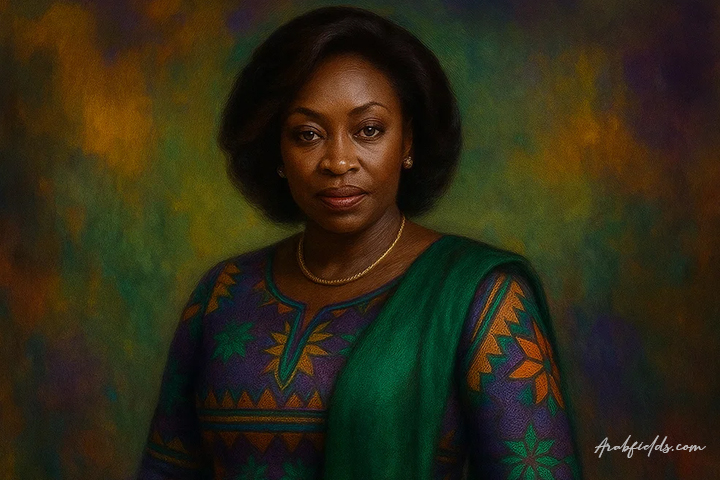
In 2025 her flagship plant in Takoradi’s industrial zone is already processing close to 50,000 tonnes a year, well beyond its official 32,000-tonne capacity. The expansion is deliberate. With world cocoa prices still hovering above $8,000 per tonne after the dramatic spikes of 2024, every extra tonne ground locally means millions kept at home instead of flowing to European or American grinders.
Patricia Poku-Diaby did not inherit a fortune in the classic sense. She was one of eighteen children born to Francis Kojo Poku, a self-made trader who moved between Ghana and Côte d’Ivoire building businesses in timber, pharmaceuticals and transport. Young Patricia grew up in the family’s trading house in Abidjan, learning early how margins are made and how trust is the real currency in African commodities. By 2010 she had struck out on her own, founding Plot Enterprise first in Côte d’Ivoire with a modest 16,000-tonne grinding unit, then returning to Ghana to build something far more ambitious.
Today Plot Enterprise Group operates across three countries, employs more than a thousand people directly, and exports cocoa liquor, butter, powder and cake to Europe, North America, Asia and even Australia. What makes her story remarkable is not just the scale, but the timing. For decades Ghana, the world’s second-largest cocoa producer, has exported almost all of its harvest raw. Less than a third is processed locally, and finished chocolate consumption inside the country remains a tiny niche. Poku-Diaby is single-handedly challenging that model.
The Takoradi factory is modern, almost clinical in its efficiency. Beans arrive from farms in the Western, Ashanti and Central regions, are cleaned, roasted, winnowed, ground and pressed into semi-finished products that fetch two to three times the price of raw beans. Hundreds of local jobs have been created, most of them filled by young women and men who never imagined working with industrial-scale machinery. Farmers who supply Plot often receive premiums above the government-fixed price, a quiet but powerful incentive to stay loyal.
Looking forward, the numbers tell a compelling story. Analysts expect global cocoa prices to ease only gradually, probably settling between $5,500 and $6,500 per tonne by 2027 as new plantings in Ecuador and Cameroon begin to bear fruit. That still leaves a comfortable margin for processors who control their own supply chain. Poku-Diaby has already announced plans to push Takoradi’s capacity toward 60,000 tonnes by the end of the decade, incorporating solar power, automated sorting lines and full blockchain traceability to satisfy the European Union’s incoming deforestation rules.
More interestingly, she has started talking openly about finished chocolate. A small pilot line producing single-origin 70% dark bars under a “Made in Ghana” label appeared in Accra’s premium groceries in late 2025. The packaging is simple, elegant, unmistakably local. If the test succeeds, a full confectionery wing could be added by 2028, creating another layer of jobs and keeping even more value inside the country.
The ripple effects reach far beyond one company’s balance sheet. Ghana’s government has made local processing a national priority, offering tax holidays in free zones and cheaper electricity tariffs for agro-industry. The African Continental Free Trade Area is slowly removing internal barriers, meaning a bar made in Takoradi could soon appear on shelves in Nairobi, Addis Ababa or Johannesburg without punitive duties. Some analysts quietly predict that Ghana’s domestic processing share could climb from today’s 30% to more than 50% by 2035, and Patricia Poku-Diaby’s plants would account for a significant slice of that growth.
Challenges remain, of course. Climate change is making rainfall patterns erratic, swollen shoot virus still devastates old farms, and the state marketing board COCOBOD occasionally struggles to deliver beans on time. Yet every obstacle seems to strengthen her resolve. She has invested in nursery programs for disease-resistant hybrids, partnered with satellite firms to give farmers precise weather advice, and even launched a micro-lending arm that offers credit at single-digit rates to women cocoa farmers.
By the end of this decade, many in the industry believe Patricia Poku-Diaby could become Africa’s first billion-dollar woman in agribusiness, not through speculation or extraction, but by doing something almost revolutionary in its simplicity: turning Ghana’s raw beans into products the world wants, right where the beans are grown.
In Takoradi the machines never stop. Day and night they grind, press and package, turning the fruit of millions of small trees into the building blocks of chocolate bars consumed thousands of kilometres away. And at the centre of it all stands a quiet, determined woman who decided long ago that Africa should no longer export its wealth in sacks. Instead, she is shipping it in containers stamped with the proud words “Product of Ghana.” The reign of the Cocoa Queen has only just begun.