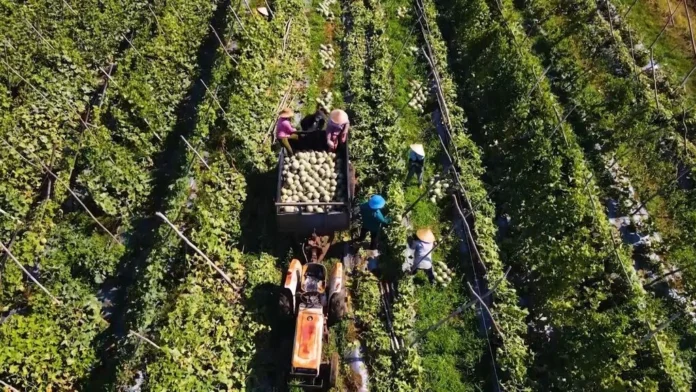
Arabfields, Meriem Senouci, Correspondent, Hanoï, Vietnam — Despite persistent disruptions in global supply chains and rising logistics expenses triggered by tensions in the Middle East, Vietnam’s agricultural, forestry, and fisheries sector has delivered solid results in the opening months of 2026. The figures underscore the industry’s resilience and its capacity to adapt to external pressures while continuing to expand.
In March alone, exports of agricultural, forestry, and aquatic products reached 6.02 billion dollars, marking a 47.8 percent increase from the previous month. For the entire first quarter, the total value climbed to 16.69 billion dollars, representing a 5.9 percent rise compared with the same period a year earlier. Agricultural exports accounted for 8.93 billion dollars, while fisheries contributed 2.62 billion dollars, both showing positive momentum. Livestock products recorded the most striking advance, surging 54.3 percent to 197.7 million dollars. Forestry exports, by contrast, stood at 4.11 billion dollars and edged down 2.4 percent, reflecting softer demand in certain overseas markets.
Asia remained the dominant destination, absorbing more than 45 percent of shipments, followed by the Americas and Europe. China continued to lead as the single largest buyer, claiming over 22 percent of the market share, ahead of the United States and Japan. Exports to Asia, Europe, and Oceania all advanced year on year. Among standout performers, pepper sales totaled 64,600 tons with notable gains in both volume and value, while rubber maintained a steady upward trajectory.
Imports of sector-related goods exceeded 11.9 billion dollars, up 3.6 percent, bringing the overall trade volume to 28.6 billion dollars. The trade surplus reached 4.78 billion dollars, an improvement of 12 percent from the corresponding quarter of 2025. These outcomes illustrate how Vietnamese producers have managed to secure additional market access even as global conditions tested supply reliability.
Looking ahead, the sector has set an ambitious target of 73 to 74 billion dollars in exports for the full year of 2026. Officials anticipate strong expansion across the three main product groups relative to the previous year. To realize this goal, emphasis will be placed on stabilizing raw-material supply chains, accelerating processing activities, and broadening the range of finished goods offered to international buyers.
The Ministry of Agriculture and Environment has urged enterprises and professional associations to act decisively amid worldwide volatility. The ongoing conflict in the Middle East has not only created immediate obstacles but has also served as a practical examination of the sector’s adaptability. Rising input costs and logistical uncertainties have placed pressure on production expenses and overall competitiveness. In response, authorities have prioritized the stabilization of output, the assurance of input availability, cost containment, and greater self-reliance in resource use. At the same time, export networks must be preserved and natural assets employed more efficiently.
A key element of the strategy involves keeping prices of fertilizers, animal feed, and plant-protection products under control. Suppliers have been encouraged to maintain or even lower their rates while optimizing capacity to guarantee uninterrupted flows to farms. Equally important is the commitment by processing companies to sustain steady purchases from growers, particularly during peak harvest periods, thereby bolstering confidence among rural communities and reducing post-harvest losses.
At processing facilities such as the ANTESCO plant in Châu Phu commune, An Giang province, workers continue to transform raw mangoes into value-added items, demonstrating the practical steps being taken to move up the value chain. These on-the-ground efforts reflect the broader determination of Vietnamese farmers and enterprises to turn challenges into opportunities through deeper restructuring of production and distribution networks. With such measures in place, the sector is positioned to navigate the remainder of 2026 with measured optimism and sustained momentum.