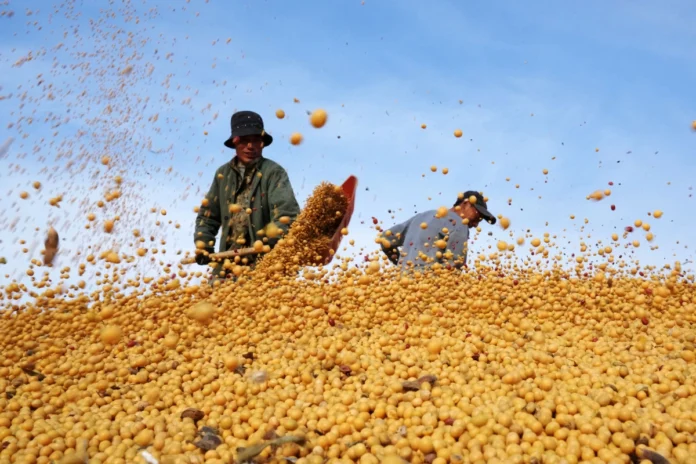
Arabfields, Naïla Mokhtari, Special Economic Correspondent, São Paulo, Brazil — In the dynamic arena of global agriculture, Brazil has solidified its position as the preeminent force in soybean production, with 2026 projections pointing to an unprecedented level of market control that continues to redefine international trade patterns. Recent assessments indicate that the South American giant is poised to gather approximately 182 million tonnes of soybeans from nearly 50 million hectares of planted area during the current season. This extraordinary yield is expected to represent more than 42 percent of total world output, a sharp increase from the 30.3 percent portion it commanded only ten years earlier, underscoring a sustained and accelerating momentum in Brazilian agricultural expansion.
Such figures highlight not just volume but a profound structural shift in how soybeans are sourced and distributed worldwide. With exports forecasted to reach around 112 million tonnes, Brazil is set to command 59.2 percent of the entire global soybean trade, a dominance that influences everything from feed prices in livestock industries to the stability of supply chains spanning continents. This level of output positions the country as a cornerstone supplier, particularly for major importers reliant on consistent access to high quality protein sources derived from the oilseed.
To understand the depth of this achievement, it is essential to trace the historical trajectory that brought Brazil to this pinnacle. Soybean cultivation in the nation began modestly in the late 19th century, initially introduced for research and experimental farming rather than large scale commerce. Commercial viability took root more firmly during the 1960s and 1970s, yet for much of that era the United States maintained overwhelming supremacy, accounting for over 60 percent of global production and roughly 56 percent of exports as far back as 1980. In contrast, Brazil operated in a supporting capacity, its potential constrained by technological gaps and limited infrastructure.
The transformation accelerated dramatically in the early 2000s, propelled by surging demand from China for soybean meal to fuel its rapidly expanding pork sector. This external pull encouraged the conversion of extensive pasturelands into productive soybean fields across Brazil’s fertile interior regions. Coupled with targeted agronomic improvements, including better soil management and adapted planting techniques, these changes allowed production to scale efficiently. Over time, Brazilian farmers embraced cutting edge seed technologies that enhanced yields, disease resistance, and adaptability to local climates, enabling the country to close the productivity gap with traditional leaders and eventually surpass them.
By the 2012,2013 marketing year, Brazil had already claimed the top spot in global soybean exports, and it ascended to the number one producer ranking during the 2017,2018 cycle. This evolution reflects a deliberate blend of policy support, private investment, and farmer innovation that has turned soybeans into a strategic economic asset. The result is a sector that not only meets domestic needs but also generates substantial foreign exchange earnings, bolstering Brazil’s broader economy as the third largest agricultural exporter overall, trailing only the European Union and the United States in that category.
As the 2026,2027 campaign unfolds, indications suggest that the United States will experience further erosion of its relative influence in this market. Projections estimate American soybean output at about 116 million tonnes for the season ahead, which would equate to roughly 26.9 percent of worldwide production, down notably from the 33.8 percent share recorded a decade earlier. On the export front, the United States is anticipated to ship approximately 42.9 million tonnes, capturing just 22.6 percent of global trade volumes compared to the 39.8 percent it held ten years prior. These trends illustrate a consistent realignment, where competing land uses, differing policy environments, and varying investment priorities in North America have tempered growth relative to the more aggressive expansion seen south of the equator.
The Brazilian advantage stems from a combination of scale, efficiency, and market responsiveness that has proven resilient even amid fluctuating global conditions. Expanded cultivation areas, optimized through modern farming methods, have delivered consistent gains without proportional increases in environmental strain when managed thoughtfully. This efficiency translates into competitive pricing on the world stage, making Brazilian soybeans a preferred choice for processors and end users seeking reliability and value. Consequently, the nation’s export infrastructure, including advanced port facilities and logistics networks, has matured to handle the massive volumes now routine, further entrenching its leadership.
Looking forward, forecasts derived from these established patterns anticipate that Brazilian soybean dominance will extend and intensify in the coming years. If the rate of market share growth observed over the past decade holds steady, the country could approach or exceed half of global production by the early 2030s, with exports potentially climbing even higher as demand from emerging economies continues to rise. World consumption of soybeans and their derivatives is projected to expand in response to population growth, rising protein needs in animal agriculture, and industrial applications such as biofuels, yet Brazil’s capacity to respond to these signals positions it as the primary beneficiary and stabilizer of supply.
This forward looking outlook also accounts for potential challenges that could test the sustainability of such leadership. Climate variability, including periodic droughts or excessive rainfall in key producing states, remains a factor that producers monitor closely through improved forecasting tools and resilient crop varieties. Investments in research continue to focus on mitigating these risks, ensuring that yield trajectories remain upward even as conditions evolve. Trade dynamics, influenced by international agreements and occasional geopolitical frictions, may introduce short term volatility, but Brazil’s diversified buyer base and cost effective production model provide a buffer that few rivals can match.
Economically, the ripple effects of this supremacy are far reaching. For Brazil, the sector supports millions of jobs in rural communities, drives infrastructure upgrades in agricultural zones, and contributes to overall GDP growth through multiplier effects in related industries like transportation, processing, and equipment manufacturing. Farmers benefit from stable income streams that encourage further innovation, creating a virtuous cycle of productivity and reinvestment. On a global scale, the concentration of supply in one highly capable producer helps moderate price swings that might otherwise arise from fragmented or less predictable sources, benefiting importers and consumers alike.
Yet the narrative extends beyond economics to encompass broader considerations of food security and agricultural geopolitics. As nations grapple with the imperative to nourish expanding populations while navigating resource limitations, Brazil’s ability to deliver large scale soybean volumes offers a dependable pillar for global feed systems. This reliability is especially valuable for Asian markets, where soybean meal underpins livestock production critical to dietary improvements and economic development. At the same time, the scale of operations prompts ongoing dialogue about best practices in land stewardship, with Brazilian stakeholders increasingly integrating sustainable techniques such as cover cropping and precision agriculture to balance output with ecological preservation.
In essence, the 2026 outlook for Brazilian soybeans encapsulates decades of strategic progress culminating in a record setting era. What began as an experimental crop has matured into a powerhouse commodity that reshapes trade balances, influences dietary patterns worldwide, and exemplifies how targeted agricultural development can elevate a nation’s role on the international stage. The continued trajectory, informed by historical gains and current momentum, suggests that Brazil will not only maintain but amplify its influence, adapting to future demands while addressing inherent challenges through ingenuity and scale.
Producers and policymakers alike recognize that preserving this edge requires vigilance against emerging threats, from technological disruptions to shifting consumer preferences toward alternative proteins. Nevertheless, the foundational strengths, evident in the projected 2026 figures and the underlying trends of expanding share, point toward a future where Brazilian soybeans remain central to global agriculture. This dominance, achieved through persistent effort rather than fleeting circumstance, stands as a compelling case study in competitive transformation within one of the world’s most vital commodity markets. As seasons progress and data accumulates, the evidence reinforces a clear pattern: Brazil’s soybean sector is built for longevity, delivering value that extends well beyond its borders and into the fabric of international economic interdependence.