Arabfields, Maleeka Kassou, East, West and Central Africa Agriculture Correspondent — The global cocoa market could return to deficit in the 2026/27 season as weather risks threaten production in West Africa while demand begins to recover from the sharp contraction caused by record prices.
Guan Chong Berhad, one of the world’s largest cocoa processors, expects the market to face a shortfall of between 300,000 and 400,000 tonnes in the coming season. The forecast marks a significant shift from the surplus recorded after the severe supply disruptions that pushed cocoa prices to historic levels.
The Malaysian processor’s chief executive, Brandon Tay Hoe Lian, said adverse weather and crop disease were among the main risks facing producers. A stronger El Niño could further complicate the outlook by increasing dryness in parts of West Africa later in the season.
The warning comes as cocoa markets enter a more uncertain phase. The International Cocoa Organization estimated global production at 4.723 million tonnes for the 2024/25 season, while grindings reached 4.628 million tonnes. That left the market with a revised surplus of 48,000 tonnes, a sharp improvement from the deficit recorded in the previous season.
But the improvement in supply has not completely restored the industry’s safety cushion. Global stocks stood at about 1.32 million tonnes at the end of the 2024/25 season, equivalent to 28.5% of annual grindings. The relatively narrow buffer means another poor harvest could quickly tighten supplies.
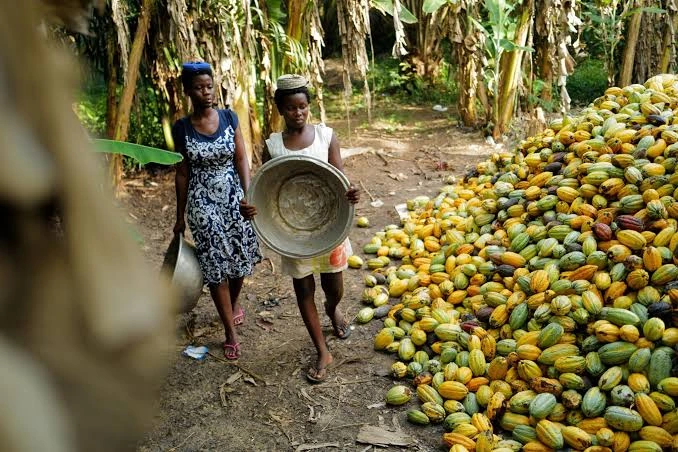
For cocoa farmers in West Africa, the figures translate into a very different reality from the one reflected in futures markets. In producing communities, farmers remain exposed to rainfall patterns, disease, input costs and the condition of ageing trees. A weak harvest can mean lower household income even when international prices remain high.
Processing companies are also watching demand closely. Global grindings fell in the 2024/25 season as manufacturers and consumers reacted to the sharp increase in cocoa prices. But recent processing data suggest that demand is beginning to stabilise in some major markets, raising the possibility that consumption could strengthen just as supply comes under pressure again.
The combination could have important consequences for prices. If production falls while grindings recover, inventories would come under renewed pressure and processors would have to compete more aggressively for available beans. Guan Chong has indicated that cocoa futures could move towards $8,000 a tonne by the end of 2026 under a tighter supply scenario.
The forecast remains subject to considerable uncertainty. Cocoa production can change rapidly with rainfall, disease conditions and crop development, while demand is sensitive to prices and consumer behaviour. Other market analysts have also maintained more moderate expectations for the 2026/27 balance, highlighting the unusually wide range of possible outcomes.
For producing countries such as Côte d’Ivoire and Ghana, the next harvest will therefore be closely watched. A return to deficit would strengthen the case for investment in farm rehabilitation, disease control and higher productivity, while potentially increasing revenues for farmers able to benefit from stronger international prices.
The market is consequently entering the next season with little room for complacency. If weather conditions deteriorate and demand continues its recovery, the small surplus recorded in the latest official balance could quickly disappear. Under that scenario, a deficit approaching the 300,000 to 400,000 tonne range would represent a substantial tightening of the global cocoa market and could keep prices elevated well into the following season.