Arabfields, Maleeka Kassou, West & Central Africa Agriculture Correspondent — The air was thick with anticipation in a packed conference room at the Yaoundé Hilton. Gathered around a giant screen, government ministers in suits, European diplomats, satellite experts, and cocoa farmers in traditional dress were all examining a new kind of image: a map of unprecedented detail, revealing the location of every cocoa tree in Cameroon and its relationship with the forest.
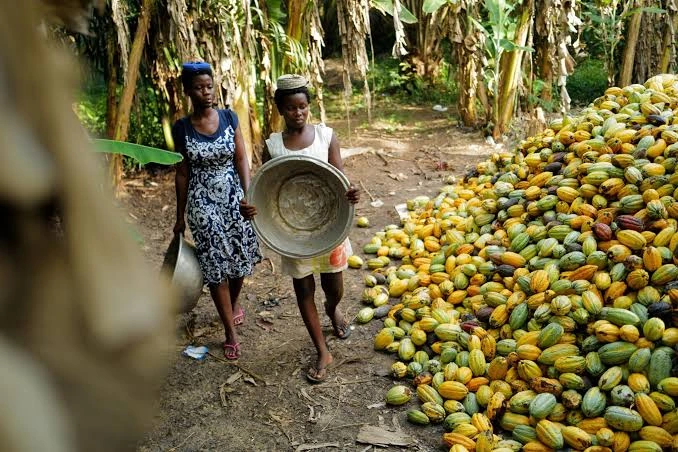
This mapping, unveiled during a three-day national workshop, is the first tangible result of the European Union-funded Sustainable Cocoa Programme (SCP), run in Cameroon by the UN’s Food and Agriculture Organization (FAO). For the 600,000 smallholders who produce the country’s 250,000 tonnes of cocoa each year, these digital images could mean the difference between keeping or losing access to their biggest market, Europe.
From 30 December 2025, the EU’s Deforestation Regulation (EUDR) will require every sack of cocoa entering the bloc to be accompanied by GPS coordinates proving it was not grown on land deforested after 2020. Fail to comply, and the entire shipment will be blocked. For Cameroon, the world’s fourth-largest cocoa exporter, the stakes are enormous.
“This is not just a map. It is a passport for the economic survival of hundreds of thousands of families,” said Fidèle Kengni, FAO Cameroon’s lead on the programme, as he clicked through slides showing green patches of agroforestry cocoa glowing against the darker blocks of primary forest. “Without proof that their beans are clean, our farmers will be shut out of Europe overnight.”
The creation of this national map is the product of a technological alliance rarely seen in African agriculture. The European Union’s Copernicus satellites provided the base imagery, processed by the computing power of Google Earth Engine. An artificial intelligence algorithm, trained on thousands of field photos, learned to distinguish a cocoa tree from other trees. Finally, on the ground, the Open Foris Ground mobile app allowed extension officers, even in the most remote villages, to photograph and geolocate trees to validate the satellite data.
The result is a dataset that can detect a single cocoa farm hidden under a canopy of mango and native timber trees with 85% accuracy, a feat previous satellite systems could only dream of under Central Africa’s perpetually cloudy skies.
The initial findings surprised even the most seasoned experts. More than 60% of Cameroon’s cocoa is already grown in shaded agroforestry systems, a world away from the full-sun plantations that have ravaged the forests of neighbouring Côte d’Ivoire.
This is reassuring news for EU regulators and a breath of fresh air for farmers who feared being lumped in with illegal clear-cutters.
“I thought they would say all cocoa kills forests,” confessed Jean-Pierre Mballa, a 52-year-old farmer from Nkongsamba who travelled to Yaoundé for the workshop. “When they zoomed in and I saw my plot with the exact number of cocoa trees and the shade trees above them, I almost cried. Now they can see that we have been protecting the forest all along.”
This new visibility opens concrete economic prospects. Mr. Mballa’s cooperative is already piloting a scheme where farmers who maintain at least 40% shade cover receive a €150-per-tonne premium from a Belgian chocolate maker. With the new maps, this type of premium could soon become the rule rather than the exception.
The Minister of Forests, Jules Doret Ndongo, who attended the closing ceremony, praised the collaborative approach, “The EU did not impose sanctions first and ask questions later.” But behind the scenes, officials admit the country has significant work ahead.
“We now have the most accurate picture we’ve ever had of where cocoa ends and protected forest begins,” a senior official from the Ministry of Forestry and Wildlife (MINFOF) revealed on condition of anonymity. “Some of the overlaps are going to be politically painful to manage. But at least we know the truth.”
This data will feed directly into Cameroon’s new national land-use plan and a forthcoming traceability platform that the government hopes to launch before the EUDR deadline.
By mid-2026, the FAO plans to hand over full control of the mapping system to a Cameroonian inter-ministerial unit. Training is already underway for 120 young technicians, half of them women, who will be tasked with keeping the maps updated using drones and smartphones.
For now, the mood in Yaoundé is one of cautious optimism. As the workshop ended, farmers and officials gathered for a photo in front of a giant print-out of the new cocoa map. Someone had stuck a Post-it note in the middle with a single sentence written in French: “Thank you Europe, but don’t abandon us now.”
Judging by the €15 million already committed and the technical firepower on display, abandonment seems unlikely. For Cameroon’s cocoa belt, the satellite age has just begun. It brings with it a fragile, yet very real, hope for a future where the flow of chocolate can continue while preserving the forest that gives it life.