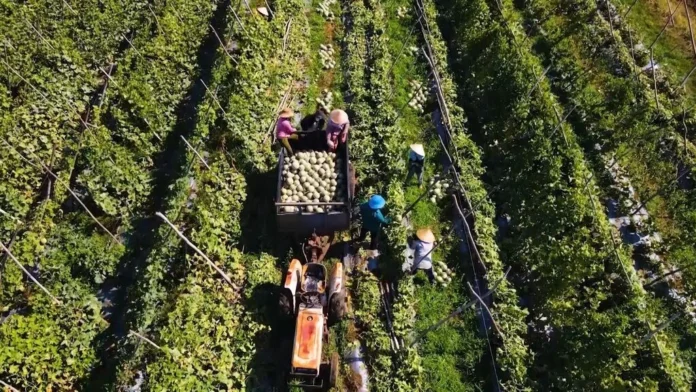
Arabfields, Farah Benali, Economic Correspondent, China — A growing network of agricultural brokers is helping Chinese farmers reach consumers directly, using livestream sales, digital marketing and improved supply chains to turn local produce into a more reliable source of income.
The shift is changing the role of intermediaries in rural China. Once primarily responsible for connecting sellers with buyers, agricultural brokers are increasingly involved in product grading, branding, logistics and production planning, as the country seeks to modernise its agricultural economy.
The opportunity is visible in Shaanxi province, where entrepreneur Li Qian turned an oversupply of locally grown kiwifruit into an online business. After conventional sales channels struggled to absorb the harvest, he began livestreaming from orchards, allowing consumers to see the fruit before ordering directly from the production area.
The approach attracted more than 300,000 orders, including over 10,000 repeat buyers, according to figures reported in October. In 2025, his agricultural brand generated sales exceeding 20 million yuan, benefiting more than 130 households.
For farmers, the change can mean a better chance of selling their harvest at a price that reflects its quality. Li’s operation introduced automated sorting and grading, helping distinguish premium fruit from produce that needed to be sold through lower-priced channels. Local residents also found work in packaging, customer service, marketing and transport.
The model is gaining attention as China looks to strengthen rural incomes and improve the connection between small producers and national consumer markets. More than one million agricultural product brokers are already active across the country, according to figures cited in Chinese media, while the government has proposed training 30,000 leading brokers during the 2026-30 period.
The scale of the ambition reflects a persistent problem in agricultural distribution. Small farms may produce high-quality fruit and vegetables but lack the marketing expertise, storage facilities and transport networks needed to reach distant customers. When supply exceeds local demand, growers can be forced to sell at a loss or leave part of their harvest unsold.
Digital platforms offer a way around some of these limitations, although online exposure alone does not guarantee a profitable business. Brokers must coordinate orders, maintain consistent quality and ensure that perishable goods arrive in good condition. Shipping costs and cold-storage capacity can quickly determine whether a successful livestream translates into sustainable earnings.
The experience of Liu Yilin, a cherry broker in Liaoning province, illustrates how the profession is expanding. His business connects growers with customers across China and overseas markets, including India and Malaysia. Beyond finding buyers, he advises partner farms on soil conditions, pests and plant diseases, helping producers prepare for future demand.
Other cooperatives are building similar networks. In Hunan province, an orange marketing model links 22 major production villages through coordinated management and centralised sales. The operation has generated cumulative sales of more than 50 million kilograms and helped increase incomes for 1,837 households, according to its organiser.
These examples suggest that the strongest models combine digital marketing with organisation at farm level. Coordinated production, transparent grading and shared distribution can make it easier for smallholders to negotiate with buyers and build customer loyalty. Cooperatives can also spread some of the costs and risks that individual farmers would struggle to manage alone.
The government is seeking to formalise the profession through training and clearer occupational standards. Agricultural brokers increasingly need expertise in digital promotion, consumer research, quality control, negotiation and financial risk management. Universities and local authorities are developing courses to help workers acquire these skills, while some provinces are expanding training programmes and professional recognition.
Hunan, for example, has set a target of training 700 market-oriented agricultural brokers annually. If these programmes expand as planned, the number of trained professionals could rise significantly over the next three years, helping more agricultural counties establish organised sales networks.
However, the sector still faces structural challenges. Brokers sometimes advance money to farmers, hold unsold inventory when prices decline and wait for customers to settle payments. Without access to working capital, adequate insurance and reliable cold-chain infrastructure, rapid sales growth can expose businesses to financial pressure.
The next phase of development will therefore depend on more than the number of people trained. Certification, credible quality standards, access to financing and stable relationships with major retailers and digital platforms will be important in determining whether the business model can be replicated across different regions and crops.
By 2030, the government’s training target could help create a larger and more professional network of agricultural intermediaries. If training is matched by better logistics and stronger cooperative structures, more rural businesses could secure repeat customers, reduce waste and capture a greater share of the value generated by their produce.
The gains are unlikely to be evenly distributed. Areas with strong agricultural cooperatives, reliable transport and products suited to online sales may advance more quickly than remote communities with limited infrastructure. For farmers, the decisive measure will remain whether new channels deliver consistent payments and more predictable incomes.
China’s agricultural brokers are emerging as a link between traditional farming and the digital economy. Their long-term success will depend on turning online attention into dependable demand, while ensuring that the benefits reach the people who grow the food.