Arabfields, Sophia Daly, Financial Analyst specialized in Agriculture and Futures Markets — In a bold move to revitalize their beleaguered cocoa industries, the world’s two largest cocoa producers, Côte d’Ivoire and Ghana, have announced substantial increases in the prices paid directly to farmers for the 2025-2026 harvest season. This decision, unveiled in early October 2025, comes at a critical juncture for the sector, which has grappled with plummeting production, environmental pressures, and economic vulnerabilities despite soaring global market prices. By elevating farmgate prices, both nations aim not only to bolster farmer livelihoods but also to stem the tide of declining output that threatens their dominant positions in the $100 billion global chocolate supply chain.
The announcements, made amid the official opening of the new cocoa season on October 1, underscore a shared strategy between the West African powerhouses, which together supply over 60% of the world’s cocoa beans. In Côte d’Ivoire, President Alassane Ouattara personally revealed the new rate of 2,800 CFA francs (approximately $4.60) per kilogram of high-quality beans, marking a significant hike from the previous season’s 2,000 CFA francs. This adjustment represents an increase of roughly 40%, positioning it as the highest farmgate price in the country’s history. Ghana, not to be outdone, followed suit with a dual escalation: an initial 60% surge in August to 3,240 cedis per 64-kilogram bag, followed by an additional 12% boost in early October, bringing the price to 3,625 cedis (about $240) per bag. These changes equate to a producer price of around GH¢56,640 per tonne, a staggering 72% leap from the prior year.
At the heart of these price revaluations lie profound structural difficulties that have eroded the cocoa filière, the entire value chain from farm to factory, over the past several years. Production capacities in both countries have “considerably reduced,” as noted in recent analyses, due to a confluence of biotic, climatic, and socioeconomic factors. In Côte d’Ivoire, the world’s top producer with an estimated output of 2.1 million metric tons for the 2024-2025 season, bean arrivals at ports and warehouses have lagged far behind expectations. By late September 2025, cumulative arrivals stood at just 1.613 million tons, a stark contrast to the robust volumes of previous bumper years. This shortfall is attributed to swollen shoot virus, a devastating disease that has ravaged plantations, compounded by erratic weather patterns including prolonged Harmattan winds and suboptimal rainfall since December 2024.
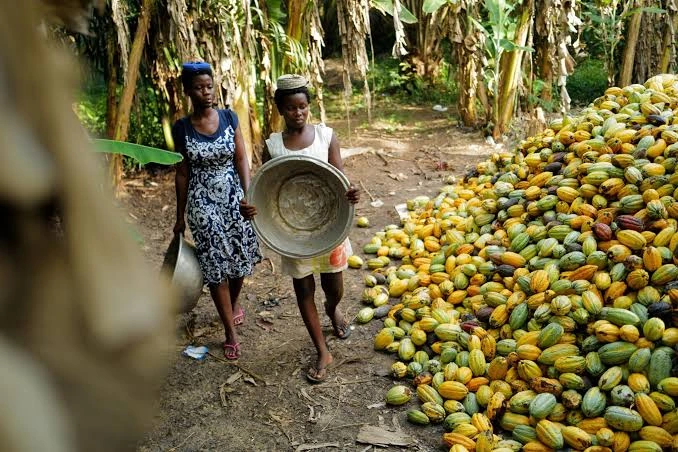
Ghana, the second-largest producer, faces similar headwinds. Its 2024-2025 harvest forecast was slashed to 617,500 metric tons, a 40% drop from initial projections, owing to the same viral outbreaks, coupled with illegal mining (galamsey) encroaching on farmland and cross-border smuggling fueled by price disparities with neighbors like Côte d’Ivoire. An estimated 160,000 tons, or a third of Ghana’s 2023-2024 output, was lost to smuggling last season alone, as farmers sought better returns across porous borders. These challenges have not only depressed local supplies but also propelled global cocoa prices to unprecedented heights, peaking at over $12,900 per metric ton in late 2024 before settling around $8,000-$8,300 by mid-2025. Yet, paradoxically, these record highs have yet to fully trickle down to the smallholder farmers who form the backbone of the industry, over 800,000 families in Ghana and millions more in Côte d’Ivoire, many of whom live below the poverty line despite their pivotal role.
The price hikes are a direct response to these pressures, designed to incentivize higher yields and restore farmer confidence. “This increase will allow our courageous producers to better cope with the rising cost of living and inputs,” Ouattara stated during the announcement, emphasizing the government’s commitment to the sector that contributes 40% of Côte d’Ivoire’s export revenues. In Ghana, Joseph Boahen Aidoo, CEO of the Ghana Cocoa Board (COCOBOD), echoed this sentiment, assuring farmers that the adjustments reflect “strong market expectations” and a strategy to outpace Côte d’Ivoire’s offerings, thereby curbing smuggling. COCOBOD’s Head of Public Affairs, Jerome Sam, added that the board is “not going to do less than what Côte d’Ivoire is doing,” signaling a competitive dynamic between the two nations to secure talent and output.
This coordinated approach builds on a decade-long collaboration through the Côte d’Ivoire-Ghana Cocoa Initiative, launched in 2017 to counter exploitative practices by multinational buyers. A cornerstone of this pact is the Living Income Differential (LID), a $400 per ton premium imposed since the 2019-2020 season to guarantee farmers a “decent” income amid volatile world prices. Buyers, including giants like Cargill, Barry Callebaut, and Mars, are contractually obligated to absorb this cost, which has now risen in tandem with the farmgate adjustments. However, the LID has not been without controversy; grinders and manufacturers have long complained that it inflates their expenses, contributing to a 30% year-on-year decline in forward contracts for the 2025-2026 season. Ghana and Côte d’Ivoire have sold just 100,000 tons forward, down from the typical 500,000, opting instead for spot market deals to capitalize on sustained tightness in supply.
The economic implications ripple far beyond West African farms. For farmers, the windfall is tangible: a typical Ivorian smallholder producing 500 kilograms annually could see their income double to over 1.4 million CFA francs ($2,300), enough to cover seeds, fertilizers, and family needs amid inflation hovering at 5-7%. In Ghana, the 129% cumulative increase from the prior season’s baseline could inject billions into rural economies, spurring investments in sustainable practices like disease-resistant varieties and agroforestry. Yet, experts caution that structural issues persist. “Higher prices are a band-aid; without addressing deforestation, climate vulnerability, and aging trees, many over 30 years old, the sector risks further contraction,” warns a report from the U.S. Department of Agriculture’s Foreign Agricultural Service.
Globally, the chocolate industry braces for sticker shock. With cocoa costs now comprising up to 70% of production expenses, companies like Hershey and Mondelēz have already reported sales dips and are reformulating products, shrinking bar sizes or substituting with cheaper alternatives. The European Union’s Deforestation Regulation, set to fully enforce by June 2026, adds another layer of compliance costs, mandating traceability for all cocoa imports to curb environmental degradation. In response, non-West African producers like Indonesia and Ecuador are ramping up output, with Indonesia eyeing a 20% export surge in 2025 to fill potential gaps.
Looking ahead, the 2025-2026 season holds promise and peril. Favorable rains in Côte d’Ivoire have boosted optimism for a mid-crop rebound, while Ghana anticipates a 70% production recovery to 560,250 metric tons. However, Fitch Solutions analysts predict that even with elevated prices, fiscal windfalls for governments may be muted due to the fixed farmgate mechanisms, which cap state revenues from exports. Smuggling remains a wildcard; if differentials with neighbors widen again, losses could mount. Moreover, currency fluctuations, the Ghanaian cedi’s 42% appreciation against the dollar in 2025, complicate pricing strategies, as COCOBOD navigates between local empowerment and international competitiveness.
Ultimately, these price revaluations represent a pivotal moment for Côte d’Ivoire and Ghana to reclaim agency in a value chain long dominated by Northern buyers. As global demand for ethical, sustainable chocolate grows, projected to hit 5 million tons by 2030, the duo’s bold stance could foster resilience, provided it pairs with investments in research, infrastructure, and climate adaptation. For the millions of planters toiling under equatorial suns, it’s a rare glimmer of equity in an industry built on their sweat. Whether this sparks a renaissance or merely delays deeper reforms remains the $8,000-per-ton question.