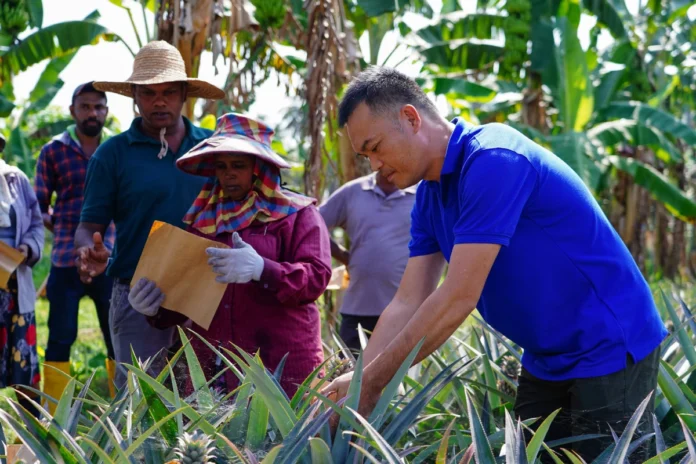
Arabfields, Farah Benali, Economic Correspondent, China — New Zealand kiwifruit marketer Zespri is considering a major change to its supply strategy in China as locally grown Gold3 fruit gains ground and intensifies competition with its premium SunGold brand.
The company is examining the possibility of sourcing selected Chinese-grown Gold3 kiwifruit through a tightly controlled procurement programme. The proposal would allow Zespri to maintain a more consistent supply of high-quality fruit throughout the year while responding to the growing presence of unauthorised production in the Chinese market.
The issue has become increasingly important as Chinese growers improve production techniques, storage facilities, branding and distribution networks. Zespri chief executive Jason Te Brake has acknowledged that locally produced Gold3 is becoming a stronger competitor, particularly towards the end of New Zealand’s export season, when fruit that has spent several months in storage faces competition from freshly harvested Chinese kiwifruit.
Estimates indicate that between 7,100 and 8,100 hectares of Gold3 are currently planted in China, with first-class fruit representing between 70 and 80 per cent of production. Annual Chinese production is estimated at approximately 45 million trays, highlighting the scale of the emerging domestic industry.
For New Zealand growers, the development raises concerns about the long-term value of their investments and the protection of intellectual property. Gold3, marketed internationally as SunGold by Zespri, is a commercially valuable variety developed through years of research and agricultural investment.
The growing availability of locally produced fruit also creates a challenge for consumers. Chinese retailers increasingly have access to fresh domestic kiwifruit at a time when New Zealand supplies are approaching the end of their season. This gives supermarkets and distributors greater flexibility when negotiating prices and selecting suppliers.
China remains one of Zespri’s most important commercial markets. The company recorded sales of NZ$1.4 billion across Greater China during the 2025/26 season, while its products are distributed through approximately 300,000 retail outlets in the Chinese market.
However, maintaining a premium position is becoming more difficult. Zespri has identified growing competition from other premium fruits, including cherries, blueberries and durians. At the same time, consumers are becoming more selective about product quality and value.
Quality consistency is another concern. In 2025, customer claims involving fruit sold from November reached as high as 22 per cent, indicating that more than one in five pieces of fruit failed to meet the company’s standards in certain sales categories. Such problems can weaken consumer confidence, particularly when fresher alternatives are available locally.
Zespri is now discussing two possible strategies with its New Zealand growers. The first would maintain production exclusively in New Zealand while increasing investment in post-harvest technology, improving late-season fruit quality and developing varieties with longer storage potential.
The second option would introduce a controlled sourcing arrangement in China. Under this approach, locally grown Gold3 could complement New Zealand supplies when domestic production no longer meets the company’s quality requirements. All fruit would have to comply with Zespri’s standards for quality, maturity and food safety, with additional monitoring of production and distribution.
For orchard owners in New Zealand, the decision involves more than commercial competition. It raises questions about how the company can protect grower returns while adapting to a market where local production is becoming increasingly sophisticated.
Te Brake has stressed that any Chinese sourcing arrangement must create value for New Zealand producers and provide local partners with clear incentives to respect the company’s standards and brand. No final decision has been taken.
Looking ahead to 2027, a producer vote could determine whether Zespri moves towards the proposed Chinese supply model, depending on the outcome of consultations with growers. The decision is likely to have implications for the company’s international sourcing strategy and its approach to protecting licensed fruit varieties.
Zespri’s 2026 season forecasts point to a record 225 million standard retail cases, equivalent to approximately 810,000 tonnes of kiwifruit. This strong production outlook provides an important commercial foundation, although maintaining quality and market access will remain essential to sustaining returns.
For Chinese consumers, a more integrated supply system could mean greater access to premium kiwifruit throughout the year. For New Zealand farmers, however, the priority will be ensuring that any expansion of Chinese sourcing does not undermine the value of their production or the reputation of SunGold.
The challenge facing Zespri is therefore increasingly strategic: protecting the value of a globally recognised brand while adapting to a market where its former competitive advantages are no longer guaranteed.