Arabfields, Sophia Daly, Financial Analyst specialized in Agriculture and Futures Markets — The cocoa market witnessed a notable downturn on Tuesday as futures contracts in both major trading hubs registered significant losses, reflecting improved supply prospects amid favorable weather developments in key producing regions. New York cocoa futures reached a one-month low, while London cocoa futures posted a one-and-a-half-week low, signaling a shift in market sentiment from earlier tightness toward expectations of greater availability. This movement aligns with broader trends observed throughout 2026, during which cocoa prices have retreated substantially from the extraordinary peaks recorded in late 2024 and early 2025.
Global cocoa production for the 2025-2026 season has shown signs of recovery, with estimates indicating output around 4.728 million tonnes, marking an increase of approximately 8.4 percent compared to prior challenged years. Grindings, which represent processing activity, stood at about 4.606 million tonnes, resulting in a modest global surplus of roughly 75,000 tonnes according to revised figures from industry observers. This surplus represents a reversal from consecutive deficits that had previously constrained supplies and propelled prices upward. End-of-season stocks have consequently begun to rebuild, reaching levels that support a stocks-to-grindings ratio near 29.2 percent, a modest improvement that eases some of the scarcity pressures experienced in recent seasons.
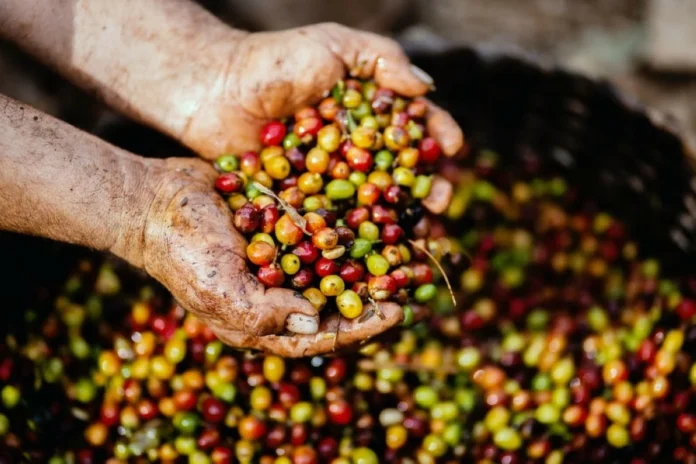
In West Africa, which accounts for the majority of world cocoa output, consistent rainfall has enhanced pod development on cocoa trees, particularly in Côte d’Ivoire and Ghana. Farmers in these countries have reported better conditions for the mid-crop harvest, contributing to optimism about overall yields. Ghana implemented a substantial reduction in the official farmgate price paid to producers for the 2025-2026 season, nearing 30 percent, while Côte d’Ivoire announced an even steeper cut of around 57 percent for the mid-crop period. These adjustments aimed to align incentives with evolving market realities and to encourage sustained production without exacerbating financial strains on smallholder farmers.
New York cocoa futures, quoted in US dollars per metric tonne, have consolidated in a range that reflects this normalization, with nearby contracts trading near 3,200 dollars per tonne as of early April 2026. This level represents a decline of over 60 percent from the all-time highs above 12,000 dollars per tonne seen in December 2024. London cocoa futures, denominated in pounds sterling and primarily reflecting African origins, have followed a parallel trajectory, with prices softening amid reduced concerns over immediate shortages. The price differential between the two exchanges has highlighted ongoing geographic and quality arbitrage opportunities within the global supply chain.
Demand dynamics have also played a role in the price adjustment. Elevated cocoa costs in prior years prompted some chocolate manufacturers to reformulate products, incorporate alternative ingredients, or reduce portion sizes, leading to a measurable contraction in industrial demand. Grinding activity in Europe and North America showed signs of moderation as processors managed inventories more cautiously. However, consumption in emerging markets across Asia and the Middle East has continued to expand, supported by rising incomes and growing preferences for chocolate and cocoa-based beverages. The global cocoa and chocolate market, valued at approximately 17 billion dollars in recent years, is projected to grow at a compound annual rate of around 4.5 percent through the early 2030s, driven largely by these demographic and dietary shifts.
Looking ahead, forecasts for the remainder of 2026 and into subsequent years point to a period of market stabilization with moderated yet structurally elevated prices. Analysts anticipate that global production could approach or exceed 5 million tonnes in favorable scenarios for the 2026-2027 season, potentially generating surpluses in the range of 250,000 to 287,000 tonnes. Such developments would further support inventory rebuilding and reduce extreme volatility. Prices in New York are expected to trade within a band of 3,000 to 3,500 dollars per tonne by year-end 2026 under baseline assumptions of normal weather, while London contracts may average the equivalent of approximately 3,400 pounds per tonne. Longer-term projections suggest a gradual descent toward 2,700 dollars per tonne within 12 months from current levels, assuming sustained supply recovery, though structural challenges could cap the downside.
Climate variability remains a critical factor influencing future supply trajectories. Unpredictable rainfall patterns, rising temperatures, and the spread of diseases such as swollen shoot virus continue to affect yields in West Africa, where aging tree stocks and limited arable land expansion constrain long-term growth potential. Initiatives to rehabilitate farms, introduce disease-resistant varieties, and promote sustainable agroforestry practices are gaining traction, yet their full impact may not materialize until the late 2020s. In contrast, Latin American producers, notably Ecuador, have capitalized on high prices to invest in expansion, with output potentially surpassing 570,000 tonnes in the current season and aiming higher in coming years. This diversification could mitigate some risks associated with over-reliance on West African supply, which historically constitutes about 70 percent of global production.
Sustainability considerations are increasingly shaping the cocoa value chain. Regulatory frameworks, including requirements for deforestation-free sourcing, are prompting investments in traceable and certified supply chains. These measures may introduce a green premium for compliant cocoa, influencing pricing differentials and encouraging producers to adopt more resilient farming methods. Smallholder farmers, who form the backbone of production, face ongoing economic pressures from price volatility, underscoring the need for stable income mechanisms and support programs to prevent shifts to alternative crops.
The chocolate industry, valued in the hundreds of billions of dollars globally, is adapting to this new equilibrium. Manufacturers are exploring innovations in product formulation to maintain affordability while preserving quality, and some are passing on residual cost adjustments to consumers in a measured manner. Demand for premium and functional chocolate products incorporating higher cocoa content or health-oriented ingredients continues to rise in mature markets, complementing volume growth in emerging regions.
In summary, the sharp decline in cocoa prices observed in 2026 reflects a transition from crisis-driven scarcity to a more balanced supply-demand environment. Improved weather, policy adjustments in producing countries, and demand moderation have collectively contributed to this correction. Nevertheless, the market retains structural strengths that are likely to keep prices above historical averages for the foreseeable future. Forward-looking projections indicate continued surpluses through 2027, fostering inventory recovery and reduced volatility, provided that weather patterns cooperate and investment in sustainable production persists. Stakeholders across the value chain, from farmers to processors and consumers, will need to navigate this evolving landscape with attention to both short-term price movements and long-term resilience factors. The coming years promise a period of normalization, yet one that preserves the fundamental importance of cocoa as a global commodity integral to cultural and economic fabrics worldwide.