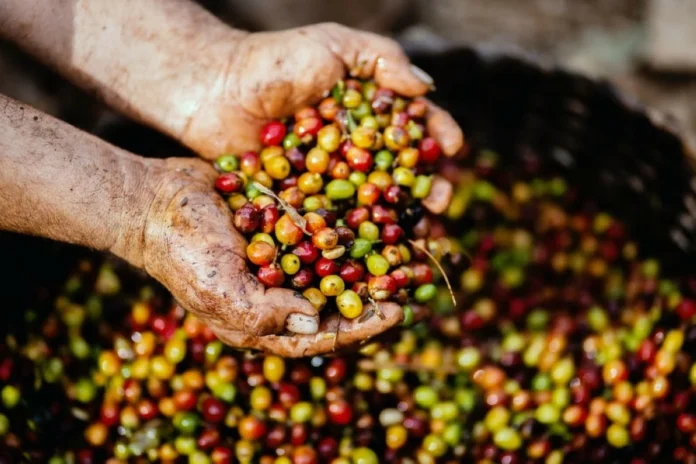
Arabfields, Maleeka Kassou, East, West and Central Africa Agriculture Correspondent — Small coffee producers across Africa are looking to revive a crop that has long struggled to compete with better-established agricultural exports, as governments and private investors turn to coffee for new sources of rural income and foreign exchange.
In Nigeria, the renewed interest has taken a more concrete form. The federal government and coffee industry stakeholders launched a 10-year coffee revival plan in May 2026, targeting production across 14 coffee-producing states. The programme focuses on improved planting material, farmer support, productivity, processing and greater private-sector participation.
For farmers, the push comes at a time when coffee production remains modest compared with the country’s agricultural potential. Nigeria’s annual output is currently estimated at around 40,800 bags, and without significant changes in cultivation and productivity, production could fall to about 39,900 bags by 2028.
That projected decline has added urgency to the government’s efforts. Coffee growers face ageing trees, limited access to improved seedlings and weak links with processors and exporters. For many smallholders, coffee is also competing with crops that offer faster or more predictable returns.
A farmer who has spent years maintaining a coffee plot can therefore face a difficult choice. Replanting an old plantation requires money and patience, while the first meaningful returns from new trees can take several years. Without reliable buyers and technical support, many producers have little incentive to make that investment.
Madagascar is pursuing a similarly ambitious strategy. The country is preparing a $150 million programme to rebuild its coffee industry, reflecting renewed confidence in the potential of smallholder production and higher-value coffee markets.
Madagascar remains an important coffee-growing country, producing mainly robusta, while its sector has suffered from years of declining productivity and structural difficulties. The new investment programme could provide support for farmers, rehabilitation of plantations and improvements across the value chain.
The revival efforts in Nigeria and Madagascar reflect a broader shift in African agriculture. Governments are increasingly looking beyond traditional export commodities and seeking crops that can generate income through local processing rather than simply through the export of raw products.
Coffee offers that possibility because value can be created at several stages, from cultivation and primary processing to roasting, packaging and branded sales. For countries with growing urban populations, stronger domestic coffee markets could provide an additional source of demand.
The opportunity is also linked to the global coffee market, where demand for differentiated origins and speciality products has created opportunities for smaller producing countries. African producers with distinctive varieties and stronger quality control could capture more value if they improve traceability and post-harvest processing.
Nigeria’s 10-year plan could begin to reverse the projected decline if farmers receive improved seedlings and better technical support on a large enough scale. Even returning output to, and then exceeding, the current level of roughly 40,800 bags would represent a significant change after years of stagnation.
Madagascar’s proposed $150 million investment could have a similar effect if funding reaches plantations and smallholders efficiently. A successful rehabilitation programme could increase yields, improve quality and strengthen the country’s position in regional and international coffee markets over the coming years.
The road ahead remains difficult. Climate variability, ageing plantations, limited rural infrastructure and weak access to finance can all slow the recovery. Coffee trees also require several seasons before new investment translates into substantial commercial production.
But the renewed attention is already changing the conversation around the crop. In Nigeria, coffee is increasingly being presented as part of the country’s drive to diversify exports and create rural jobs. In Madagascar, investment plans are putting the sector back on the economic agenda.
For small farmers, the promise is more immediate. A healthier plantation and a reliable buyer can mean a more stable household income. For governments, the calculation is broader, with every additional tonne of coffee offering the possibility of more processing, more rural employment and additional export earnings.
If the current revival programmes are implemented consistently, African coffee production could begin to recover gradually rather than through a sudden surge. By the end of the decade, the biggest gains are likely to come not simply from planting more trees, but from improving yields, quality and the share of the final coffee value retained within producing countries.