Arabfields, Maleeka Kassou, East, West & Central Africa Agriculture Correspondent — The recent dip in international Arabica coffee prices serves as a stark reminder of the commodity market’s relentless volatility, a reality acutely felt in export-dependent economies such as that of the Democratic Republic of the Congo.
As of the week of December 22 to 27, 2025, the global benchmark price for Arabica coffee stood at 6.72 US dollars per kilogram, reflecting a notable decrease of 3.44 percent compared with the previous week’s level of 6.96 dollars. This latest retreat follows an earlier modest decline of 1.69 percent during the December 15–20 period, when the price had already slipped from 7.08 dollars. These consecutive downward movements, while relatively moderate on a weekly basis, illustrate the ongoing pressure exerted by shifting dynamics of global supply and demand, compounded by various supply chain considerations that continue to influence trader sentiment.
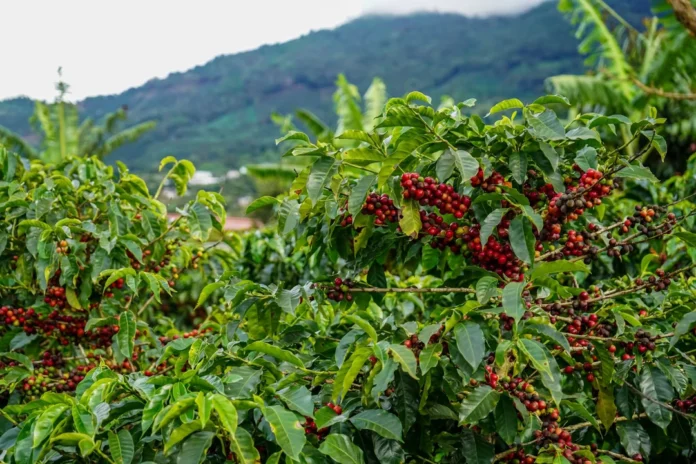
For the Democratic Republic of the Congo, where coffee cultivation remains concentrated along the scenic yet challenging shores of Lake Kivu, such international price fluctuations carry outsized implications. Although the country produces both Arabica and Robusta varieties, with Arabica grown at higher elevations, the sector has long struggled to regain the prominence it enjoyed decades ago, when coffee ranked as one of the nation’s leading export earners after copper. Persistent security challenges in eastern regions, logistical bottlenecks, informal taxation along export routes, and widespread smuggling toward neighboring countries continue to constrain official export volumes and prevent the sector from realizing its considerable agronomic potential.
Looking ahead, most market analyses and projections point toward a gradual easing of Arabica prices over the coming years, driven primarily by anticipated improvements in global production, particularly from dominant producer Brazil. Forecasts suggest that the 2026/27 Brazilian crop could reach between 71 and 74.4 million bags, representing a substantial recovery from recent cycles and paving the way for a meaningful replenishment of worldwide inventories. Analysts anticipate that this enhanced supply outlook, bolstered by favorable weather patterns in key growing regions during late 2025, will exert downward pressure on prices throughout much of 2026 and into 2027. Several prominent institutions project an overall decline in Arabica values of around 13 percent in 2026, followed by a further softening of approximately 5 percent in 2027, after exceptionally elevated levels experienced during 2025.
This expected moderation arrives after a period of historically high prices triggered by earlier weather disruptions, inventory tightness, and structural supply constraints across major origins. While short-term volatility cannot be ruled out, particularly if adverse climatic events strike Brazil or second-largest Arabica producer Colombia, the prevailing consensus among commodity researchers envisions a transition toward greater balance between supply and demand by late 2026 or early 2027. Global output is widely expected to surpass consumption during the 2026/27 marketing year, potentially generating a surplus in the range of 7 million bags, a development that would further support the downward trajectory.
For Congolese producers and exporters, these prospective trends present a double-edged sword. On one side, lower international prices could reduce revenue from existing shipments in the near to medium term, placing additional strain on smallholder farmers already contending with elevated production costs, limited access to finance, and the enduring effects of regional instability. On the other side, a period of relatively stable or declining prices might stimulate global consumption, which has been somewhat restrained by the exceptionally high quotations seen in recent years. Increased demand could eventually open new opportunities for high-quality origins such as those from the Kivu region, renowned for their distinctive cup profiles when properly processed.
The path forward for the Congolese coffee sector will likely depend on parallel domestic efforts to address longstanding structural weaknesses. Initiatives aimed at improving washing and processing infrastructure, streamlining export procedures, reducing informal barriers along trade corridors, and strengthening traceability could help position Congolese Arabica more competitively on international markets, even in a lower-price environment. Moreover, growing international interest in African specialty coffees, combined with ongoing support from development partners, suggests that gradual recovery remains within reach, provided security conditions permit greater stability in production zones.
In summary, the current softening of Arabica prices, as documented in late December 2025, appears to mark the beginning of a broader correction phase that many observers expect to unfold over the next two years. While this evolution may initially challenge export earnings for countries like the Democratic Republic of the Congo, it simultaneously lays the groundwork for renewed demand growth and, potentially, a more sustainable future for coffee growers if concerted actions are taken to overcome internal constraints. The interplay between global supply recovery and local resilience will ultimately determine whether this latest price cycle becomes a temporary setback or an opportunity for meaningful sectoral renewal.