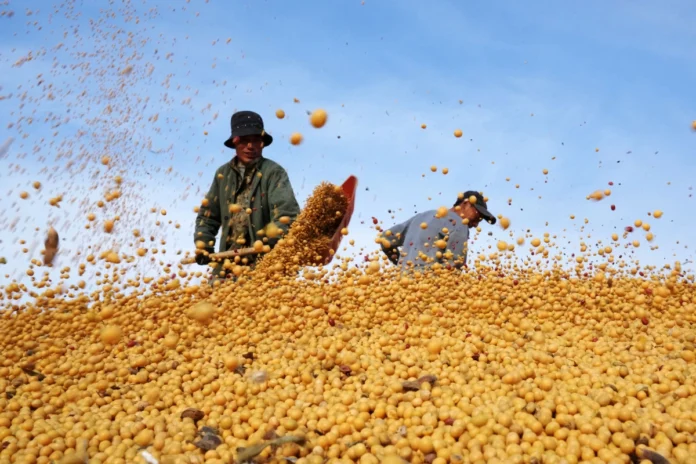
Arabfields, Isabela Valentina Montemayor, Correspondent, Mexico — Brazil, long established as the world’s leading soybean producer and exporter, is on the verge of yet another monumental achievement in its agricultural sector. Forecasts indicate that the 2025/26 marketing year will deliver a staggering record harvest of 182.2 million metric tons, marking an increase of approximately 4 million tons over previous estimates and solidifying the country’s dominance in global oilseed production. This projected output represents not just incremental growth, but a continuation of Brazil’s remarkable trajectory, where expansive farmland, technological advancements, and resilient farming practices converge to push boundaries year after year.
The story of Brazilian soybeans is one of transformation and ambition. Over the past two decades, the nation has steadily overtaken traditional powerhouses like the United States, leveraging vast tracts of arable land in regions such as Mato Grosso, Paraná, and Goiás to expand cultivation at an unprecedented pace. What began as a strategic focus on converting pastures and cerrado savannas into productive fields has evolved into a sophisticated industry, supported by investments in genetically improved seeds, precision agriculture, and infrastructure that facilitates rapid transport to ports. This expansion has been fueled by consistent demand from major importers, particularly China, whose appetite for animal feed and vegetable oils has propelled Brazil to export volumes that routinely exceed 100 million tons annually. The upcoming record harvest builds directly on this foundation, reflecting favorable planting conditions in recent seasons and an anticipated boost in both planted area and average yields.
Looking ahead, the implications of this 182.2 million metric ton harvest extend far beyond Brazil’s borders, promising to reshape global supply dynamics in profound ways. With such abundant production, Brazil is likely to flood international markets with even greater volumes of soybeans, potentially driving exports to new highs well above the already impressive figures seen in prior years. This surge could provide a buffer against disruptions elsewhere, such as weather challenges in competing nations, ensuring steady supplies for processors and consumers worldwide. However, the sheer scale of this output may exert downward pressure on prices, offering relief to buyers in importing countries while challenging producers to maintain profitability amid potentially lower margins. As global demand for plant-based proteins and biofuels continues to rise, driven by population growth and shifting dietary preferences, Brazil’s increased availability positions it as an indispensable stabilizer in the commodity chain.
Future seasons appear equally promising, with trends suggesting that Brazil’s soybean production could climb even higher in the coming years. If current patterns of area expansion persist, coupled with ongoing improvements in yield through drought-resistant varieties and sustainable farming techniques, outputs might approach or surpass 190 million metric tons by the end of the decade. Such growth would further entrench Brazil’s leadership, allowing it to capture a larger share of emerging markets in Asia, Africa, and Europe, where urbanization and rising incomes fuel demand for meat and dairy products that rely heavily on soy-based feed. Moreover, domestic policies promoting biodiesel blends and renewable fuels could absorb a greater portion of the crop internally, diversifying utilization and reducing vulnerability to export fluctuations. This dual pathway of international trade and homegrown consumption hints at a resilient model, one capable of weathering economic shifts or trade tensions.
Yet, this optimistic outlook is tempered by considerations of sustainability and environmental stewardship. Brazil’s soybean boom has historically involved clearing significant natural habitats, raising concerns about deforestation and biodiversity loss in sensitive biomes like the Amazon and Cerrado. In response, industry stakeholders have increasingly adopted certification programs and moratoriums aimed at zero-deforestation supply chains, ensuring that future expansions prioritize already-cleared lands or degraded pastures. As the 2025/26 record harvest unfolds, these efforts will likely intensify, with technology such as satellite monitoring and traceability systems playing pivotal roles in verifying responsible practices. Looking further ahead, climate variability poses both risks and opportunities, warmer conditions and altered rainfall patterns could necessitate adaptive strategies, but innovative irrigation and soil management might mitigate impacts, sustaining yield gains over the long term.
Economically, the projected record will inject substantial vitality into Brazil’s rural communities and national treasury. Soybeans remain a cornerstone of agricultural GDP, generating employment for millions across planting, harvesting, logistics, and processing sectors. The additional 4 million tons anticipated in this cycle translate to heightened revenues for farmers, even if prices soften, while bolstering foreign exchange reserves through exports. This influx supports infrastructure development, from road upgrades to port expansions, creating a virtuous cycle that enables even greater efficiency in subsequent years. On a broader scale, Brazil’s success story inspires neighboring South American countries to emulate similar models, fostering regional cooperation in research and trade agreements that could amplify collective output.
In the realm of global food security, Brazil’s forthcoming harvest arrives at a critical juncture. With geopolitical uncertainties affecting traditional supply routes and dietary shifts accelerating worldwide, the reliability of Brazilian soybeans offers a reassuring anchor. Future predictions point toward sustained dominance, where annual productions routinely break records, driven by demographic pressures and the inexorable rise in protein consumption. As nations grapple with feeding growing populations amid resource constraints, Brazil’s capacity to deliver ever-larger harvests positions it as a key player in averting shortages and stabilizing markets. This trajectory also underscores the potential for soybeans in addressing nutritional needs, from direct human consumption in processed foods to indirect roles in livestock and aquaculture.
Beyond immediate horizons, the evolution of Brazil’s soybean sector hints at transformative possibilities. Advancements in biotechnology could yield varieties optimized for carbon sequestration, aligning agricultural expansion with climate goals and opening doors to premium markets valuing low-emission products. Similarly, integration with circular economy principles, such as utilizing byproducts for energy or fertilizers, might enhance overall efficiency, reducing waste and environmental footprints. If these innovations scale alongside continued area growth, productions in the 2030s could redefine what is possible, potentially exceeding 200 million metric tons under optimal scenarios. Such milestones would not only affirm Brazil’s agricultural prowess but also contribute meaningfully to global sustainability efforts, balancing abundance with responsibility.
The 2025/26 season, with its landmark 182.2 million metric tons, thus serves as a pivotal chapter in an ongoing narrative of progress. It encapsulates decades of strategic development while foreshadowing a future where Brazil’s soybeans continue to feed the world, adapt to challenges, and drive economic prosperity. As harvesting approaches and fields yield their bounty, the world watches with anticipation, recognizing that this record is merely a stepping stone to greater achievements ahead.